

A Slice of Heaven: The East India Company’s Persian Gardens
“Of what use a dish of roses to thee? Take a leaf from my Rose-Garden, A flower endures only five or six days, but this rose garden is always delightful”. Saadi’s Golestan.
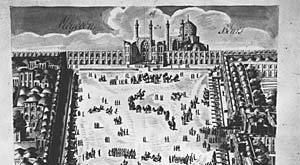
Of all aspects of Persianate culture experienced by English travellers and merchants, very few left the same depth of impression as Persian gardens. The bagh (garden) can be traced back to antiquity as a feature of urban and palace planning and design, providing a mixture of water, open and covered outside space that combines natural and built environments. An impression of these spaces can be most clearly appreciated by the fact that the word for these gardens in Old Persian has come down to the present day through ancient Greek as “paradise”. The Safavids were no exception to the tradition of building and using gardens as places of public entertainments, business and relaxation. The most notable example being the Naqsh-i Jahan square, which forms the centrepiece of the city after Abbas I made it his capital. The grandeur of Isfahan’s gardens and tree-lined boulevards did not detract from their functional role in the commerce and social life of the city, which was immediately apparent to European visitors, not least the merchants of the East India Company.
The Englishmen recognised the importance of the garden in Persian social and commercial life and adopted it, purchasing their own gardens at their factories (trading establishments) in Isfahan and Bandar Abbas. At Isfahan, the Company’s factory was surrounded by a garden which was guaranteed a supply of water by the Company’s Farman from the city’s system of qanats (waterways). At Bandar Abbas, however, it was neither possible, nor desirable to keep a garden in the town, which was famed for its stifling heat and rampant illnesses. Instead, the Company’s merchants had a garden at a remove from the town in the hills nearby at a town known to them as Afseen. Here the weather was cooler and natural springs made cultivating plants and trees easier, while additionally providing clean and safe drinking water. At both Afseen and Isfahan, the Company used their gardens to entertain local notables and travellers, whether Persian or European. Especially in the case of Afseen, travelling nobles and wealthy merchants would request the use of the Company’s garden as a rest stop. The gardens assisted the Company in developing and maintaining good relations with other merchants and Persian officials alike, not to mention giving the Company’s employees a place to rest and recuperate themselves. The Company lavished considerable sums on keeping their garden in good repair and stocking it with fine plate, food and wine. According to Alexander Hamilton, a former East India Company merchant, the garden produced excellent fruit, and was worth the expense of keeping it, as it granted the Company considerable prestige amongst those who were invited to use it. The garden proved such a success, in fact, that two Persian gardeners were hired on an enviable salary and dispatched to Bombay to establish similar spaces, along with chests of seeds. The Company were apparently unaware that India had, in fact, long ago adopted this Persian tradition.
Image: Great Bazaar of Isfahan, 1703, drawing by G. Hofsted van Essen, Leiden University Library, accessed here

