

- OVERVIEW
- TIMELINE
- BIBLIOGRAPHY
Approximately five centuries before Shah Ismail I (r. 1501-1524) would take his place as the founding ruler of the Safavid Dynasty (1502-1736) of Persia, Abu’l-Qasim Firdawsi (940-1020) penned his epic poem Shahnameh, a literary masterpiece describing the legends, myths, and histories of Iran’s kings prior to the Arab conquest of the seventh century. The poet’s answer to the erosion of Iranian language, tradition, religion and land was to compose approximately 60,000 rhyming couplets unifying the widely dispersed oral narratives about the cycle of kingship, the value of honour and fidelity and the preservation of culture. Acting as a reminder for future generations to this end, Firdawsi’s Shahnameh often provided a roadmap during troubled times to guide leaders toward Iran’s central value system as well as most recurrent vulnerabilities.
It is no wonder, then, that Shah Ismail I would turn to Firdawsi’s tome for such direction after assuming the role of founder of the Safavid dynasty and Shah of Iran. Since the Arab conquest, Iran had become susceptible to multiple incursions from their neighbours who saw the slow dissolution of Iranian power structures as an opportunity to invade and carve up the former empire. Arab caliphs, Turkic sultans and Mongol khans all invaded and ruled over a fragmented empire, save a short period of rule by the Iranian Buyids in 945-1055 CE. Just as Firdawsi sewed the pieces of Iranian oral culture together through poetry, Shah Ismail I sought to stitch Iran back together again by implementing methods of reunification, especially through religion and art.
Upon defeating the Aq Qoyunlu tribal confederation and reclaiming Tabriz from their forces in 1501, Shah Ismail I proclaimed himself Shah of Azarbaijan (and of Iran a year later) and declared Twelver Shiism as the official religion of his empire. This shift in religious affiliation would separate Safavid subjects from their Sunni neighbours, assisting Ismail I in his mission to counteract attacks from their enemies who were then deemed as infidels. His mission proved to be a difficult one to fulfill, as his later reign was marked by a series of major blows. Just two years after he lost Khurasan to the Uzbeks in 1512, he was defeated in the Battle of Chaldiran by Ottoman Sultan Selim I (r. 1512-1520). Although Safavid forces temporarily lost Tabriz in this battle, they were ultimately able to retake it in a counterattack, forcing the Ottomans to retreat. In order to ensure the preservation of what reunification he could manage, he ceded control of the coveted trade port of Hormuz to Portugal, who, in turn, offered protection against the Ottomans.
In the same year as the Battle of Chaldiran in 1514, Ismail I requested the production of his own version of Firdawsi’s Shahnameh, but died of a fever in 1524 before seeing the completed text. His son and successor, Shah Tahmasp I (r. 1524-1576), would oversee the completion of this edition of Shahnameh, a magnificent codex with 258 detailed and ornate illustrations depicting scenes from the epic poem, 759 folios and gilded leather binding. In an act of diplomacy as well as a demonstration of Persian prominence, Tahmasp I would later gift this invaluable text to Sultan Selim II (r. 1566-1574) in 1567.
The transfer of power from Ismail I to his ten-year-old son, Tahmasp I, in 1524 proved to be a contentious one. Surrounded by advisors from the Qizilbash tribes and the settled urban elites known as ‘Tajiks’ – two different groups with two different ideas about the future of the empire – Shah Tahmasp I saw his father’s work of unification deteriorate into civil war. As the empire fell into disarray, its enemies saw an opportunity to gain territory, and the hotly contested city of Tabriz fell to the Ottomans once more. With an eye toward strengthening Iran’s position amongst its neighbours, however, Tahmasp I entered negotiations with Sultan Suleyman I (r. 1520-1566), and in 1555, the two sides agreed to the terms outlined in the Treaty of Amasya. While this agreement would regularise Perso-Ottoman relations, it would do so at a great cost: the Safavids regained control of Tabriz and other north-western territories as well as an equal share of the newly divided lands of Armenia and Georgia, but they lost control of Baghdad and most of Iraq giving the Ottomans unrestricted access to the Persian Gulf.
In the same year that the Treaty of Amasya was instituted, Queen Mary I of England (r. 1553-1558) approved the establishment of the Muscovy Company, with voyages later sanctioned by her sister and successor, Queen Elizabeth I (r. 1558-1603). As a response to the successful mercantile missions initiated in Spain and Portugal to the West and East Indies, respectively, English monarchs set their sights on establishing an exclusive Anglo-Persian trade agreement through a northern passage to Persia via Russia and the Caspian Sea – a route unclaimed by other European explorers. The earliest expeditions took England’s merchants, led by Anthony Jenkinson, to Tahmasp I’s court with an official proposal from Elizabeth I. The Safavid Shah refused this proposal as well as the five additional attempts the merchants made on behalf of their queen across 20 years (a total of six expeditions from 1561-1581). Not only was the Shah uninterested in granting this request because of its deficiencies in facilitating his empire’s interests, he was also hesitant to enter into an agreement that might compromise negotiations with the Ottomans.
Despite his efforts to secure stability for his people, Tahmasp I’s death in 1576 brought renewed uncertainty to Iran, propelling it into its second civil war under the Safavids. It took over a decade before the Safavids could establish more stability with the reign of the most formidable Safavid leader, Shah Abbas I (r. 1588-1629). In the first decade of his reign, Abbas I was successful not only in recovering some territories in the northeast by defeating the Uzbeks but also establishing a burgeoning national economy that blossomed with the move of the Persian capital from Qazvin to Isfahan. Just before this transfer, Abbas I celebrated his military successes as he proceeded homeward, finding two English travellers awaiting his arrival. Anthony and Robert Sherley, sons to the disgraced MP Thomas Sherley, arrived at the Safavid court in 1598 against the wishes of their queen. After the embarrassing failures of the Muscovy Company expeditions, Elizabeth I primarily redirected her mercantile and diplomatic interests toward the Ottomans, and negotiating with the Persians might have undermined these attempts. The two brothers, hungry for adventure and for the opportunity to return honour to their family name through fame, voyaged to Persia anyway, ultimately becoming representatives, or ilchi, to Abbas I. The brothers would mistranslate their posts as envoys to ‘ambassador,’ adding weight and importance to their positions for their countrymen who read about their adventures.
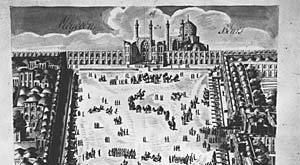
In Isfahan, construction on the famed city centre called Naqsh-e Jahan (‘the map of the world’) began in 1602, which welcomed travellers and traders from all over the world under the Safavids and continues to be a popular tourist attraction. It is within the vibrancy of this city centre that Abbas I followed in his great-grandfather’s and father’s footsteps by ensuring that the traditions of the Shahnameh continued during his reign. It was customary for naqqals, or performers of oral poetry, to recite famous episodes of the Shahnameh from memory using expressive tones and elongated vowel sounds that connected each line in one continuous utterance – a specific manner of poetic reading that still exists today. These naqqals reinvigorated the tradition of oral storytelling, making poetry like Firdawsi’s accessible to a wider audience. It was perhaps through these figures and with the help of translators that European travel writers learned about important characters from Firdawsi’s epic. One such traveller is Sir Thomas Herbert, who journeyed to Persia on a diplomatic mission in 1626. His travel account, Some Yeares Travaile, first published in 1634 includes a summary from a scene in Shahnameh. That the story would not see an English translation until 1774 (by Sir William Jones) suggests that Herbert encountered the popular narrative at these public events with the help of a translator.
Despite the foundation painstakingly begun by Ismail I and Tahmasp I and fortified into a bastion of mercantile, architectural, and diplomatic advancement under Abbas I, the Safavid dynasty would crumble over the course of its second century in power. Yet, immediately following the death of Abbas I, the Safavid Empire experienced a great deal of prosperity and promise. Whereas the succession of rulers had been contentious in the past, later Safavid shahs would assume their roles as leaders of the realm with much concord and seamlessness. Despite this ease of transition, no other shah of the Safavid period would ever match the success of Abbas I who had left an indelible mark on Iran and a profound impression on rulers in Europe and Asia alike.
Abbas I’s successor and grandson, Shah Safi I (r. 1629-1642) was successful in improving Perso-Ottoman relations with his role in instituting the Treaty of Zuhab, through which the Safavids regained control of Tabriz. His son, Shah Abbas II (r. 1642-1666), furthered this understanding by solidifying a Perso-Ottoman trade agreement that officially opened trade routes between the Safavid and Ottoman empires. But these important, yet modest, advancements in international relations would be some of the last victories for Iran. Under Shah Suleiman I (r. 1666-1694), Iran experienced a series of disasters such as a devastating famine that left nearly 70,000 citizens dead in the late 1670s. Yet more perished as a result of the three-year plague beginning in 1684.
The ruler known as the final Safavid shah was Sultan Husayn (r. 1694-1722) who oversaw the construction of Chahar Bagh – the period’s defining architectural feat – but also the fall of the city that had become the centre of Safavid success, Isfahan. What began as a localised rebellion by Afghan forces under Mahmud Hotaki (r. 1717-1725) culminated in the Battle of Gulnabad (1722), the effects of which permeated into the rest of the empire. After a series of stunning defeats, Sultan Husayn abdicated the throne, and Mahmud assumed power despite resistance to the new Afghan regime. Sultan Husayn’s son, Tahmasp II (r. 1729-1732), declared himself Shah and attempted to regain control of lands lost, but he was unsuccessful in coalescing a formidable backing. While Tahmasp II was a less than inspiring figure, he was well served by his leading general, who would eventually depose the last Safavid, the infant Abbas III (r. 1732-1736). This general, known at the time as Tahmasp Qoli Khan, is better known to history by his regnal title, Nadir Shah (r. 1736-1747). He defeated Mahmud Hotaki and began his twelve-year reign as Nadir Shah in 1736.
Curated by Lubaaba Al-Azami and Samera Hassan
Written by Dr Nedda Mehdizadeh
A Note on Terminology
Both ‘Persia’ and ‘Iran’ will be utilised to represent different understandings of the geographical space that is the subject of this project. Deriving from Pars, the name of a region in southwestern Iran bordering the Persian Gulf and the site of the ancient Persian capital, ‘Persia’ was a Greek misattribution that replaced one part of Iran for the entire country – a misattribution that would linger for centuries to come. ‘Iran,’ on the other hand, is derived from the Old Persian ariyanam (ariya, ‘noble, lordly’) and is the name that has always been used to refer to the country by native Iranians (Irooni). Greek historians would later refer to it as Persis, which would, over time, become Persia. It was not until 1934 that Reza Shah Pahlavi instituted a decree asking all foreign nations to refer to his country by its appropriate assignation, Iran. The country and its people will be referred to as ‘Iran’ and ‘Iranians’ for this project when discussing Iranian history and literature. However, ‘Persia’ and ‘Persians’ will be employed when referring to early modern European references in order to maintain fidelity to the manner in which non-Iranian writers, thinkers and travellers envisioned and understood the country.
Ismail I (r. 1502-1524)
1501 Ismail I (1487-1524) defeats Aq Qoyunlu Turkman dynasty, reclaims the city of Tabriz from Mongolian forces, names it the capital of the Safavids, claims himself Shah of Azarbaijan and declares Twelver Shiism as the official religion of his empire.
1502 Ismail I declared Shah of Iran.
1512 Uzbeks take Khurasan.
1514 Tahmasp I, son of Ismail I, is born.
1514 Battle of Chaldiran: Ismail I is defeated by Selim I; the Ottomans gain control over north-western Iran but ultimately lose Tabriz in a counter-attack and are forced to retreat.
1514 Ismail I commissions the production of an edition of the Shahnameh. The project is completed under his successor, Tahmasp I.
1515 Ismail I cedes control of Hormuz to Portugal in exchange for alliance against the Ottomans.
1524 Ismail I dies of a fever.
Tahmasp I (r. 1525-1576)
1524 Shah Tahmasp I (1514-1576) is named Shah of Iran.
1526 Civil War takes hold; following Ismail I’s death, two tribes – Qizilbash and Tajik – clash over mentoring the new 10-year-old Shah. Because these tribes are at odds, tensions arise, exposing Iran’s position amongst its neighbours. The Uzbeks and Ottomans strike, gaining Iranian territory. The Ottomans temporarily occupy Tabriz.
1532 Mohammad Khodabanda, son of Tahmasp I, is born.
1537 Ismail II, son of Tahmasp I, is born.
1543 Civil War ends.
1535-1537 Completion of Tahmasp I’s Shahnameh (begun under Ismail I’s rule in 1514).
1546 Alqas Mirza, Tahmasp I’s half-brother, colludes with the Ottomans to stage an unsuccessful revolt against Tahmasp I.
1555 Treaty of Amasya; Tahmasp I and Suleyman I regularise Perso-Ottoman relations. The terms include an equal division of Armenia and Georgia, Ottoman control of Baghdad and most of Iraq granting them access to the Persian Gulf, and Safavid control of Tabriz and north-western territories. Due to the continued Ottoman threat to Tabriz, Tahmasp I names Qazvin as the new capital of Iran.
1555 Tahmasp I imprisons Ismail II; he refuses to have him killed despite advisors’ requests.
1556 Haydar, Tahmasp’s son by his Georgian wife, is born; he is favoured for succession.
1561 The Muscovy Company begins its first expedition to Persia, led by lead agent, Englishman Anthony Jenkinson.
1567 Tahmasp I gifts his Shahnameh to Selim II.
1571 Abbas I, son of Mohammad Khodabanda and grandson of Tahmasp I, is born.
1576 Tahmasp I dies and the Second Civil War begins.
Ismail II (r. 1576-1577)
1576 Tahmasp I’s favoured successor, Haydar, is captured and killed. Ismail II (1537-1577) is freed from prison and is named Shah of Iran.
1577 Ismail II dies, possibly after an overdose of opium.
Mohammad Khodabanda (r. 1577-1587)
1577 Mohammad Khodabanda (1532-1595) is named Shah of Iran. Although he was older than Ismail II, he was passed over for succession due to his blindness from an eye affliction.
1585 The Ottomans capture Tabriz.
Abbas I (r. 1587-1629)
1587 Abbas I (1571-1629) becomes Shah of Iran.
1590 Abbas I defeats the Governor of Shiraz, Yaqub Khan Dhul-Qadr, marking the end of the Second Civil War.
1595 Mohammad Khodabanda dies.
1597-1598 Isfahan becomes the new capital for the Safavid Empire.
1598 Anthony and Robert Sherley of England arrive in Persia.
1602-3 Work on Naqsh-e Jahan begins. This famous site becomes the city centre of the new capital in Isfahan and includes the following: on the north side of the plaza, is the maydan, including the entrance to the bazaar which depicts artwork commemorating Abbas I’s successes over Uzbeks; on the south side of the plaza is the Shah Mosque; on the east side is the Mosque of Shaikh Lutfallah; on the west side is Ali Qapu, the shah’s palace, behind which sits a series of gardens that leads to Chahar Bagh, a boulevard leading to parks as well as palaces for the royal family.
1605 Abbas I commissions the production of a new royal Shahnameh.
1611 Work on Masjid-e Shah, or the Shah’s Mosque, begins in Isfahan.
1611 Safi I, grandson of Abbas I, is born.
1617 Pietro della Valle, Italian travel writer, arrives in Isfahan and remains in Persia for more than five years.
1622 With the help of the English East India Company, Abbas I expels the Portuguese from Hormuz.
1626 English East India Company embassy to Persia begins. This expedition is led by English ambassador Sir Dodmore Cotton who travels with his gentleman attendant Sir Thomas Herbert, author of Some Yeares Travaile, first published in 1634.
1629 Abbas I dies.
Safi I (r. 1629-1642)
1629Safi I (1611-1642) becomes Shah of Iran.
1630 Ottoman forces occupy Hamadan.
1632 Abbas II, son of Safi I, is born.
1634 Saru Taqi named grand vizier to Safi I.
1635 Ottoman forces gain temporary control over Tabriz.
1638 Baghdad is lost to Ottoman forces.
1639 Treaty of Zuhab; this treaty ends 150 years of Perso-Ottoman wars. Iran regains control of Tabriz through this treaty.
Abbas II (r. 1642-1666)
1642 Abbas II (1632-1666) becomes Shah of Iran.
1643 Jean-Baptiste Tavernier, famed French merchant and traveller, arrives in Isfahan for the first time.
1645 Suleiman I, son of Abbas II, is born.
1645 Abbas II has Saru Taqi and other associates executed and replaces his advising team with a new coalition led by Siyavash Bek.
1649 Abbas II reclaims Qandahar from Mughals.
1655 Muhammad Bek named vizier to Abbas II.
1655 Work begins on the Vank Cathedral.
1657 A Perso-Ottoman trade agreement is established as a result of the Treaty of Zuhab and the consequent reopening of trade routes.
1666 Abbas II dies.
Suleiman I of Persia (r. 1666-1694)
1666 Suleiman I (1648-1694) (initially Safi II) becomes Shah of Iran and his first accession ceremony takes place. The two years that follow are marked by turmoil including a powerful earthquake and Cossack raids of the Caspian Sea.
1668 Second accession ceremony for Suleiman I takes place where he assumes his new title. This ceremony is reenacted to offset the inauspicious beginning of his reign.
1668 Sultan Husayn, son of Suleiman I, is born.
1675 Sir John Chardin, French traveller and jeweller, first arrives in Qazvin.
1678-9 Nearly 70,000 citizens die of famine as a result of drought.
1684 The beginning of a three-year period marked by plague occurring in various areas of Iran, especially Ardabil, Azerbaijan and Isfahan.
Sultan Husayn (r. 1694-1722)
1684 Sultan Husayn (1668-1726) becomes Shah of Iran.
1694 The Catholic Carmelite Order is banned from Isfahan.
1704 Tahmasp II, son of Sultan Husayn, is born.
1704-5 Work begins on the Chahar Bagh complex, consisting of the Chahar Bagh school, bazaar and sarai quarters. This project becomes the defining architectural feature under Sultan Husayn.
1709 Afghan uprisings trouble Sultan Husayn’s relatively peaceful beginning as Shah of Iran.
1722 Battle of Gulnabad; Isfahan falls to Afghan forces.
1722 Peter the Great, tsar of Russia, declares war against the Safavids. This year marks the fall of the Safavids.
Tahmasp II (r. 1722-1731)
1722 Tahmasp II (1704-1740) proclaims himself Shah in Qazvin. Although never a shah of Iran, Tahmasp II did attempt to maintain Safavid rule, albeit unsuccessfully.
1724 Russians take Hamadan.
1725 Ottoman forces take Tabriz.
1726 Sultan Husayn is executed.
1729 Tahmasp II takes control of Isfahan; a Russian-Safavid treaty ensues.
1736 Nader Afshar (Tahmasp Qoli Khan) becomes Nader Shah (r. 1736-1747) (thus ending the Safavid dynasty).
1740 Tahmasp II is executed.
By Dr Nedda Mehdizadeh
Andrea, Bernadette. The Lives of Girls and Women from the Islamic World in Early Modern British Literature and Culture. Toronto: University of Toronto Press, 2017.
Andrea, Bernadette. Women and Islam in Early Modern English Literature. Cambridge: Cambridge University Press, 2007.
Blow, David. Shah Abbas: The Ruthless King Who Became an Iranian Legend. I. B. Tauris, 2009.
Brummet, Palmira. “The Myth of Shah Ismail Safavi: Political Rhetoric and ‘Divine’ Kingship.” In Medieval Christian Perceptions of Islam: A Book of Essays, edited by John Victor Tolan, pp. 331-59. New York; London: Garland, 1996.
Burton, Jonathan. “The Shah’s Two Ambassadors: The Travels of the Three English Brothers and the Global Early Modern.” In Emissaries in Early Modern Literature and Culture: Mediation, Transmission, Traffic, 1550-1700, edited by Brinda Charry and Gitanjali Shahani, pp. 23-40. Farnham: Ashgate, 2009.
Burton, Jonathan. Traffic and Turning: Islam and English Drama, 1579-1624. Newark: University of Delaware Press, 2005.
Canby, Sheila R. The Shahnama of Shah Tahmasp. New York: The Metropolitan Museum of Art, 2011.
Dale, Stephen F. The Muslim Empires of the Ottomans, Safavids, and Mughals. New York; Cambridge: Cambridge University Press, 2010.
Davies, D. W. Elizabethans Errant. Ithaca: Cornell University Press, 1967.
Davis, Dick. Epic and Sedition. Fayetteville: The University of Arkansas Press, 1992.
Eskandari-Qajar, Manoutchehr. “Persian Ambassadors, their Circassians, and the Politics of Elizabethan and Regency England.” Iranian Studies, vol. 44, no. 2, (March 2011): pp. 251-271.
Ghatta, Javad. “Persian Icons, Shi‘a Imams: Liminal Figures and Hybrid Persian Identities on the English Stage.” In Early Modern England and Islamic Worlds, edited by Bernadette Andrea and Linda McJannet, pp. 53-72. New York: Palgrave Macmillan, 2011.
Grogan, Jane. The Persian Empire in English Renaissance Writing, 1549-1622. Basingstoke: Palgrave Macmillan, 2014.
Houston, Chloë. “‘Thou glorious kingdome, thou chiefe of Empires’: Persia in early seventeenth-century travel literature.” Studies in Travel Writing, vol. 13, no. 2, (2009): pp. 141-52.
Houston, Chloë .“Turning Persia: The Prospect of Conversion in Safavid Iran.” In The Turn of the Soul: Representations of Religious Conversion in Early Modern Art and Literature, edited by Harald Hendrix, Todd Richardson, and Lieke Stelling, pp. 85-108. Boston: Brill, 2011.
Matthee, Rudolph P. The Politics of Trade in Safavid Iran: Silk for Silver, 1600-1730. New York: Cambridge University Press, 1999.
Matthee, Rudolph P. Persia in Crisis: Safavid Decline and the Fall of Isfahan. I.B. Tauris & Co. Ltd, 2012.
Mazzaoui, Michel, ed. Safavid Iran and Her Neighbours. Salt Lake City: University of Utah Press, 2003.
McJannet, Linda. The Sultan Speaks: Dialogue in English Plays and Histories about the Ottoman Turks. Basingstoke: Palgrave Macmillan, 2006.
Mehdizadeh, Nedda. “The Petrification of Rostam: Thomas Herbert’s re-vision of Persia in A Relation of Some Yeares Travaile.” In Re-mapping Travel Narratives in the Early Modern World: to the East and Back again, edited by Montserrat Piera, pp. 111-127. Amsterdam: ARC Humanities Press, 2018.
Mehdizadeh, Nedda. “Robert Sherley and the Persian Habit.” In England’s Asian Renaissance. University of Delaware Press, Forthcoming.
Newman, Andrew J. Safavid Iran: Rebirth of a Persian Empire. I.B. Tauris & Co., 2006.
Publicover, Laurence. “Strangers at home: The Sherley brothers and dramatic romance.” Renaissance Studies, vol. 24, no. 5, (2010): pp. 694-709.
Quinn, Sholeh. Shah Abbas: The King who Refashioned Iran. London: OneWorld Publications, 2015.
Rizvi, Kishwar. “The Suggestive Portrait of Shah ‘Abbas: Prayer and Likeness in a Safavid ‘Shahnama.’” The Art Bulletin, vol. 94, no. 2 (2012): pp. 226-250.
Schleck, Julia. Telling True Tales of Islamic Lands: Forms of Mediation in English Travel Writing, 1575-1630. Susquehanna University Press, 2011.
Introductory Pre-Modern Race Theory
Compiled by Hassana Moosa
Akhimie, Patricia. Shakespeare and the Cultivation of Difference: Race and Conduct in the Early Modern World. New York: Routledge, 2018.
Archer, John M. Old Worlds: Egypt, Southwest Asia, India, and Russia in Early Modern English Writing. California: Stanford University Press, 2001.
Arvas, Abdulhamit. "Early Modern Eunuchs and the Transing of Gender and Race." Journal for Early Modern Cultural Studies19.4 (2019): 116-136.
Ballaster, Ros. Fabulous Orients: Fictions of the East in England 1662–1785. Oxford: Oxford University Press, 2005.
Bartels, Emily C. Speaking of the Moor: From" Alcazar" to" Othello". Philadelphia: University of Pennsylvania Press, 2008.
Barthelemy, Anthony G. Black face, maligned race: the representation of blacks in English drama from Shakespeare to Southerne. Louisiana: LSU Press, 1987.
Bovilsky, Lara. Barbarous Play: Race on the English Renaissance Stage. Minneapolis: University of Minnesota Press, 2008.
Britton, Dennis A. Becoming Christian: Race, Reformation, and Early Modern English Romance. New York: Fordham University Press, 2014.
Burton, Jonathan. Traffic and Turning: Islam and English Drama, 1579-1624. Delaware: University of Delaware Press, 2005.
Chakravarty, Urvashi. "More Than Kin, Less Than Kind: Similitude, Strangeness, and Early Modern English Homonationalisms." Shakespeare Quarterly 67.1 (2016): 14-29.
Corredera, Vanessa. "“Not a Moor exactly”: Shakespeare, Serial, and Modern Constructions of Race." Shakespeare Quarterly 67.1 (2016): 30-50.
d'Amico, Jack. The Moor in English Renaissance Drama. Florida: University of Florida Press, 1991.
Dadabhoy, Ambereen. "The Moor of America: Approaching the Crisis of Race and Religion in the Renaissance and the Twenty-First Century." Teaching Medieval and Early Modern Cross-Cultural Encounters. Palgrave Macmillan, New York, 2014. 123-140.
Degenhardt, Jane H. Islamic Conversion and Christian Resistance on the Early Modern Stage. Edinburgh: Edinburgh University Press, 2010.
Erickson, Peter, and Clark Hulse, eds. Early modern visual culture: Representation, race, and empire in Renaissance England. Philadelphia: University of Pennsylvania Press, 2000.
Erickson, Peter, and Kim F. Hall. "A New Scholarly Song”: Rereading Early Modern Race." Shakespeare Quarterly 67.1 (2016): 1-13.
Erickson, Peter. "Invisibility speaks: Servants and portraits in early modern visual culture." Journal for Early Modern Cultural Studies 9.1 (2009): 23-61.
Espinosa, Ruben and David Ruiter eds. Shakespeare and Immigration. New York: Routledge, 2016.
Fuchs, Barbara. "The Spanish Race" in Rereading the Black Legend: the discourses of religious and racial difference in the Renaissance empires eds. Margaret R. Greer, Walter D. Mignolo, & M.Quilligan.Chicago: University of Chicago Press, 2007.
Feerick, Jean E. Strangers in Blood: Relocating Race in the Renaissance. Toronto: University of Toronto Press, 2010.
Floyd-Wilson, Mary. English ethnicity and race in early modern drama. Cambridge: Cambridge University Press, 2003.
Gillen, Katherine. Chaste Value: Economic Crisis, Female Chastity and the Production of Social Difference on Shakespeare's Stage. Edinburgh: Edinburgh University Press, 2017.
Habib, Imtiaz. Black Lives in the English Archives, 1500-1677: Imprints of the Invisible. Vermont: Ashgate, 2008.
Habib, Imtiaz. Shakespeare and race: Postcolonial praxis in the early modern period. Maryland: University Press of America, 2000.
Hall, Kim F. Things of darkness: Economies of race and gender in early modern England. New York: Cornell University Press, 1995.
Hendricks, Margo, and Patricia Parker eds. Women,'Race' and Writing in the Early Modern Period. London: Routledge, 1994.
Heng, Geraldine. The invention of race in the European Middle Ages. Cambridge: Cambridge University Press, 2018.
Iyengar, Sujata. Shades of difference: Mythologies of skin color in Early Modern England. Philadelphia: University of Pennsylvania Press, 2005.
Jones, Eldred D. Othello's Countrymen: The African in English Renaissance Drama. Published on behalf of Fourah Bay College, the University College of Sierra Leone [by] Oxford University Press, 1965.
Jones, Eldred D. The Elizabethan Image of Africa. Charlottesville: University of Virginia Press, 1971.
Kaplan, Paul HD. "Black Turks: Venetian Artists and Perceptions of Ottoman Ethnicity.’’ in The Turk and Islam in the Western Eye, 1450–1750: Visual Imagery before Orientalism ed. James G. Harper. Farnham: Ashgate, 2011.
Little, Arthur L. Shakespeare Jungle Fever: National-Imperial Re-Visions of Race, Rape, and Sacrifice. California: Stanford University Press, 2000.
Loomba, Ania. Gender, race, renaissance drama. Manchester and New York: Manchester University Press, 1989.
Loomba, Ania, and Jonathan Burton, eds. Race in Early Modern England: A Documentary Companion. Basingstoke: Palgrave Macmillan, 2007.
MacDonald, Joyce G. Women and race in early modern texts. Cambridge: Cambridge University Press, 2002.
Pierce, Leslie. “An Imperial Caste: Inverted Racialization in the Architecture of Ottoman Sovereignty” in Rereading the Black Legend: The Discourses of Racism in the Renaissance Empires eds. Margaret R. Greer, Walter D. Mignolo, & M.Quilligan. Chicago: University of Chicago Press, 2007.
Robinson, Benedict. Islam and Early Modern English Literature: The Politics of Romance from Spenser to Milton. Basingstoke: Palgrave Macmillan, 2007.
Shahani, Gitanjali G. Tasting Difference: Food, Race, and Cultural Encounters in Early Modern Literature. New York: Cornell University Press, 2020.
Singh, Jyotsna G. Colonial narratives/cultural dialogues:" discoveries" of India in the language of colonialism. New York: Routledge, 1996.
Smith, Ian. Race and Rhetoric in the Renaissance: Barbarian Errors. New York: Palgrave Macmillan, 2009.
Thompson, Ayanna. Performing race and torture on the early modern stage. New York: Routledge, 2013.
Thompson, Ayanna, eds. The Cambridge Companion to Shakespeare and Race. Cambridge: Cambridge University Press, 2021.
Vaughan, Virginia M. Performing Blackness on English Stages, 1500-1800. New York: Cambridge University Press, 2005.
Whitaker, Cord J. Black Metaphors: How Modern Racism Emerged from Medieval Race-Thinking. Philadelphia: University of Pennsylvania Press, 2019.
Young, Sandra. The Early Modern Global South in Print: Textual Form and the Production of Human Difference as Knowledge. Farnham: Ashgate, 2015.
The Pursuit of Hecatompylos: A Persian Capital in the Early Modern English Mind

‘Not many Bookes’? Persian Literary Culture in Early Modern European Travel Writing

What is an ‘Afghan Tartar’? A Short Overview of a Puzzling Phrase

“Ipolita the Tartarian:” A Living Diplomatic Gift for Elizabeth I

Trials and Tribulations on the Early Modern Hajj
Celebrating 100 MEMOs blog posts