

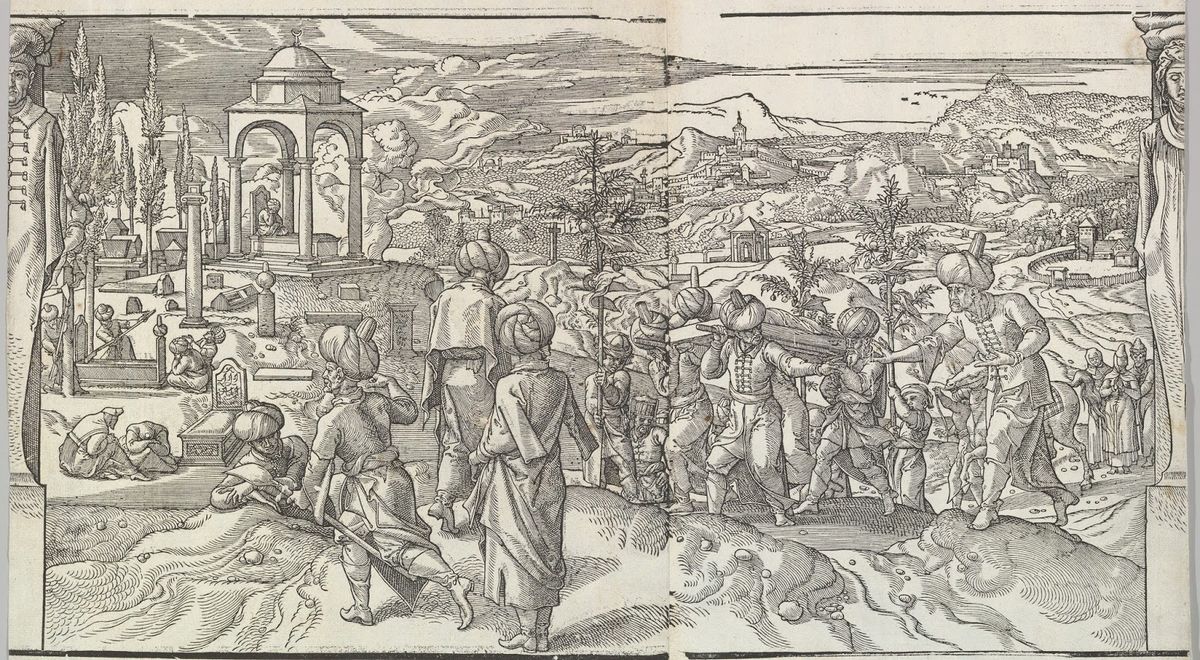
Beyond the "Fatalistic Turk": Challenging Myths of Ottoman Responses to the Plague
Much of the disease history pertaining to the Ottoman Empire is about bubonic plague, which is generally referred to in Ottoman documents as taun or veba. The disease associated with the fourteenth century "Black Death", bubonic plague is a highly infectious and often fatal bacterial infection caused by the bacterium Yersinia pestis. It is primarily transmitted through the bite of infected fleas, which commonly infest rodents such as rats. Humans can also contract the disease through direct contact with infected tissues or bodily fluids. Having prevailed in the region long before the establishment of the Ottoman Empire, it was responsible for mass deaths from Byzantium times to the Tanzimat era and had a major impact on trade, commerce, and demographics in the region throughout the early modern era.[1]
Many of us know of the Black Death (1346-1352), which constituted a fiery start to the Second Plague Pandemic (mid 14th - early 19th century), as a demographic event of unique significance. The sudden loss of perhaps 50–60% (or even “only” 30%) of the population of Europe, North Africa, and Western Asia created dramatically different economic, social, political, and cultural situations.[2] Over the course of the next several centuries, bubonic plague continued to exist in Europe in the form of periodic and repeated epidemics until the late seventeenth century, which suggests the presence of plague reservoirs in Europe independent of transmission through trade routes. However, Europeans had begun to take measures that many believed to be ultimately effective. The imposition of quarantines, undertaken with increasing effectiveness in Italy, especially in the sixteenth and seventeenth centuries, and in place thereafter, might have been among the measures that most significantly contributed to the disappearance of the Second Plague Pandemic from Western Europe by the seventeenth century. However, the plague lingered on for much longer in the Middle East, especially the Ottoman lands, as well as in the Russian Empire well into the nineteenth century. Although the last major outbreak of plague in Europe occurred in Marseille in 1720, it was a recurring event in the Ottoman and Russian empires. A devastating epidemic in 1771 in Moscow left 50,000 dead (1/5th of the population), while a plague epidemic in Istanbul in 1778 was said to have taken the lives of a third of the population of 600,000 people.[3] Present-day scholars have cast doubt on attributing all these deaths solely to bubonic plague,[4] asking whether Orientalist plague scholarship was quick to attribute a large number of deaths to plague when Ottoman sources themselves distinguished between taun (generally referring to bubonic plague) and veba (more generally referring to an epidemic disease). Nonetheless, one can still understand how the absence of plague in Western Europe and the presence of recurring plague events in the Ottoman and Russian east gave credence to some essentialist ideas regarding the ‘East.’ On one hand, it vindicated the rather harsh quarantine measures practiced in Western Europe, as well as necessitated their continuation and further implementation in various cities and ports of Europe. On the other hand, the plague fuelled the miasma-based idea that places in the Ottoman and Russian Empires, which were commonly designated as the ‘East,’ could actually be endemic geographical sources of plague or contagion and ‘exporters of plague.’[5]
Many early modern European travellers to the Ottoman lands were struck by the frequent plague epidemics they encountered, as well as the comparatively different attitudes demonstrated by Muslim populations in the face of plague outbreaks, which appeared to them lax and ‘fatalistic’ when compared with erstwhile European and Western attitudes towards plague. Struck by this difference, these travellers left behind accounts where they attempted to document their experiences. Historians of disease writing in the 1970s and 80s overly relied on these early European accounts, since they lacked access to Ottoman documents on plague events. In doing so, non-Ottomanist plague scholarship has largely mapped out the ways in which we study and understand plague in Ottoman lands. In the minds of eighteenth-century European observers, the persistence of plague in the region ultimately came to signify that the Ottoman Empire was a “plague exporter.” This went hand in hand with the implementation of quarantine and the establishment of cordons sanitaires to protect Europe against onslaughts of plague from Ottoman lands. The other notion inherent in these eighteenth-century works is the idea of Turkish/Ottoman fatalism in the face of the plague, giving rise to the notion of the “fatalistic Turk” in numerous European accounts.
However, later scholarship has both problematised and challenged these earlier accounts. Although it is true that one will occasionally come across Islamic texts and scholarly discussions asking residents not to flee, people on occasion did flee, and authorities understood this; religious directives were not necessarily as important as practical considerations on the ground. Scholars such as Yaron Ayalon have noted that since the beginning of the Ottoman empire, sultans, central and provincial officials, jurists (qadis), as well as ordinary Ottoman subjects, responded to life-threatening situations such as the plague in ways that had little to do with religious beliefs or scholarly notions of flight and contagion.[6] In this regard, while officials generally sought to curb the propensity towards flight by imposing imperial orders, one will find many examples, from Ottoman and even European historical records, that show the general flight of the populace from plague during the early modern period.[7]
In fact, one can find contemporary European records themselves documenting instances of Ottomans fleeing the plague. During a severe plague in Istanbul in 1544, a French priest named Jérôme Maurand noted that many people, including himself, took refuge in the vineyards outside Galata, indicating the flight of urban populations to nearby villagers or rural spaces within reasonable reach during times of plague.[8] In 1592, the Venetian bailo Lorenzo Bernardo observed that the belief against fleeing from plague was declining in the Ottoman Empire and that experience was teaching people that avoiding infected persons saved lives. He noted that he witnessed the mufti of Constantinople himself fleeing the city to his garden to avoid the plague, while the Sultan took care to avoid contact with his generals. Despite describing Ottoman fatalism and its religious roots in his well-known The Present State of the Ottoman Empire (1665), British diplomat Paul Rycaut (d. 1700) also remarked on how some Turks tried to avoid plagues by leaving plague-infested cities. This especially included the qadis and men of the law, although Rycaut also questioned their motives by questioning their courage.[9]
However, such accounts, which did not fit in well with the European stereotype for Muslim fatalism, did not gain much acceptance in Europe.
Title Image: Pieter Coecke van Aelst (Netherlandish, Aelst 1502–1550 Brussels), Detail from a Turkish Funeral from the frieze Ces Moeurs et fachons de faire de Turcz (Customs and Fashions of the Turks), 1553 (Source: The Metropolitan Museum of Art, Harris Brisbane Dick Fund, 1928 http://www.metmuseum.org/art/collection/search/375771)
[1] Nukhet Varlik, Plague and Empire in the Early Modern Mediterranean World: The Ottoman Experience, 1347-1600, First paperback edition (Cambridge University Press, 2017).
[2] Joseph P. Byrne and J. N. Hays, ‘The Black Death Begins: The Second Plague Pandemic, 1346-1352’, in Epidemics and Pandemics: From Ancient Plagues to Modern-Day Threats (ABC-CLIO, LLC, 2021), 2:28.
[3] Vladimir Hamed-Troyansky, ‘Ottoman and Egyptian Quarantines and European Debates on Plague in the 1830s-1840s’, Past & Present 253, no. 1 (2021): 240, https://doi.org/10.1093/pastj/gtaa017.
[4] Sam White, ‘Rethinking Disease in Ottoman History’, International Journal of Middle East Studies 42, no. 4 (2010): 555–58.
[5] Varlik, Plague and Empire in the Early Modern Mediterranean World, First paperback edition, 70–71.
[6] Yaron Ayalon, Natural Disasters in the Ottoman Empire: Plague, Famine, and Other Misfortunes (Cambridge University Press, 2014), 78.
[7] Ayalon, Natural Disasters in the Ottoman Empire, 72; White, ‘Rethinking Disease in Ottoman History’, 553; Nukhet Varlik, Plague and Empire in the Early Modern Mediterranean World: The Ottoman Experience, 1347-1600 (Cambridge University Press, 2015), 240–46.
[8] Varlik, Plague and Empire in the Early Modern Mediterranean World, 241.
[9] Varlik, Plague and Empire in the Early Modern Mediterranean World, 81.
