

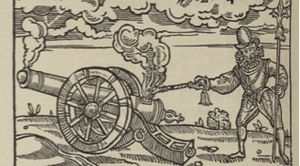
Edward Webbe: An English Gunner in the 1582 Ottoman Festivity
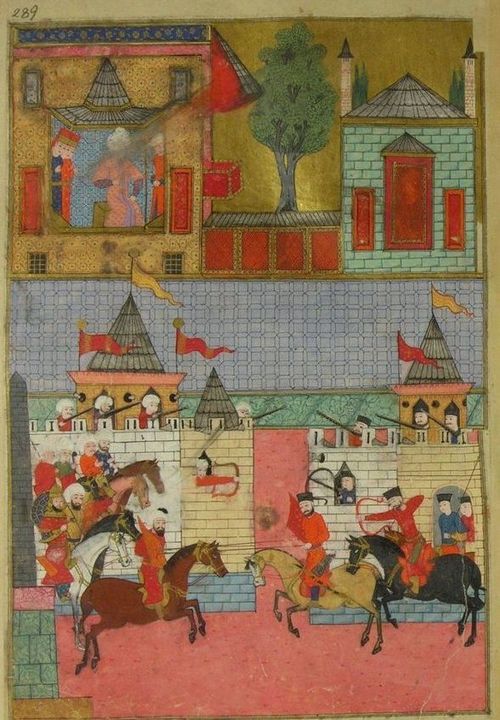
Image of a mock battle from the 1582 festivities from the Surname‑i Hümayun available via Tarihteninciler
The 1582 festivity was the biggest festivity in Ottoman history in regard to the number of guests, performances, and the money spent. Documented in 427 miniatures by the court miniaturist Nakkaş Osman (?-?) in the only copy of Surname‑i Hümayun, it was held by Murat III for his son’s circumcision and lasted for fifty-seven days and nights. Partly organised to intimidate the Iranian ambassador and to show the power of the empire, there are many local and foreign sources that document the event aside from Ottoman sources. In order to give you a view of the scale of this festivity, archival material provides evidence that even the budget of the festivity was made six months in advance. This could be seen, for instance, in the special tribune constructed for the event that was 70 metres in width to accommodate all the state officials and foreign envoys from all over the world in one of the biggest international festivities of the 16th century. Partying hard, the military band, the Mehter, played intermittently throughout the festival, starting in the morning until 10 or 11 at night. During the performances on the sixth day of the festival, about 500 grotesque-looking actors, the Tulumcu, performed their antics. Many plays were performed by actors, like the one described by a German traveller, Nicholas von Haunolt, who states that he saw plays about masters, old people, and their young servants, which reminded him of Commedia dell’Arte performances. From mock battles, sword fighting, shadow theatre, rope dancers, and many more shows, fireworks were also very important components in creating awe and delight for the 1582 audience.
The success of the use of pyrotechnics was partly due to the presence of Edward Webbe (1554-?), an English gunner held captive by the Ottomans. Before his captivity, Edward Webbe had continued the family tradition of being a gunner and sea captain and sailed in his first campaign to Russia in 1570. But along with many other Englishmen, Webbe was captured in 1571 in present day Crimea. After being ransomed, Webbe sailed to Tunis yet again, eventually fell into the hands of the Ottoman Turks and became a galley slave in 1572. As part of his enslavement, Webbe was forced to serve the Ottoman army as a master gunner against the Safavids for many years. Despite the formal establishment of Anglo-Ottoman relations with the 1580 Ahdname that granted freedom to the English in Ottoman realms, Webbe had to serve the Ottomans until 1588 when he was finally ransomed by William Harborne, the English ambassador to the Ottomans. When Webbe arrived in London, he soon recounted his experiences in Ottoman service in his 1590 book entitled The Rare and Most Wonderfull Things which Edw. Webbe an Englishman Borne, Hath Seene And Passed In His Troublesome Travailes.
Referred to briefly in this account, we know also through Ottoman sources that Webbe prepared one of the many shows with fireworks in the 1582 festivity held by Murat III. Webbe constructed a great replica of Noah’s Ark to which he added two dragons that shot fire with 13 thousand firecrackers. It is highly possible that Webbe did not just bring in his own expertise in pyrotechnics in this show, but also learned a lot during his experience before and during 1582, as the Ottomans had a long tradition of using fireworks in festivities and entertainments. As a reflection of the general multicultural characteristics of the Ottomans, the people who were responsible for fireworks in such entertainments consisted of Turks, Jews, Orthodox Christians, people of several religious backgrounds from the Balkans, and slaves from all over the world. Accordingly, there were many ingenuine pyrotechnics constructed by the Ottomans beside Webb’s Ark and dragons. For instance, lamps were placed in such way to outline figures of animals and objects. Similarly, fireworks were used that shot like fountains, zigzag flares, or stars, and even told stories by placing artful fireworks in certain order. Special mechanisms as high as nine metres created awe in the beholders. One of these very original shows included a pair of great automata of two ships that hung at two ropes and shot fireworks at each other. While Webbe, as a direct consequence of his captivity, does, for the majority, not speak in favour of the Ottomans in his Troublesome Travailes, it is very likely that he gained much knowledge and wisdom through his encounter with them.
Title Image: Edward Webbe, Image from LUNA, PR1120.A8 no. 10
Selected Bibliography
And, Metin. Osmanlı Tasvir Sanatları: 1. İstanbul: Yapı Kredi Yayınları, 2014.
Atasoy, Nurhan, Osman, Ayşe Üçok, and Bahadır Taşkın. 1582 Surname-I Hümayun: Düğün Kitabı. İstanbul: Koçbank, 1997.
Hime, H. W. L. “The Travels of Edward Webbe.” The English Historical Review 31.123 (1916): 464-470.
Nutku, Özdemir. Meddahlık ve Meddah Hikayeleri. 2nd ed. Ankara: Atatürk Kültür Merkezi Yayını, 1997.
Nutku, Özdemir. Zaman İçinde Zaman. İstanbul: Opus Kitap, 2014.
Raiswell, Richard. “Webbe, Edward (b. 1553/4), soldier and adventurer.” Oxford Dictionary of National Biography. Oxford: Oxford University Press, 2004.
Sevengil, Ahmet Refik. Türk Tiyatrosu Tarihi I: Eski Türklerde Dram San’atı. Ankara: Milli Eğitim Basımevi, 1969.
