

From Ottoman Envoy to English Swindler: The Significance of “Chiaus (Çavuş)” in The Alchemist
Introduction
In early seventeenth-century England, the representation of the Ottoman Turk was shaped not only by religious controversy and political rivalry but also by diplomatic encounters, commercial exchanges, and the circulation of foreign words. Ben Jonson’s The Alchemist (1610) provides a particularly revealing example of how these cultural encounters could be transformed into theatrical language. In Act 1, Scene 1, Jonson introduces the term chiaus, a word derived from the Ottoman Turkish çavuş, which referred to an official performing various functions within the Ottoman administrative and diplomatic system. Although the original term did not inherently signify dishonesty, its use in early modern English acquired associations with fraud and deception. Jonson exploits this semantic transformation to construct a comic exchange in which Turkish identity becomes synonymous with the possibility of being cheated. The significance of chiaus therefore extends beyond a passing linguistic curiosity: it reveals how the encounter between England and the Ottoman Empire could produce new meanings that reflected English anxieties about foreignness, commercial vulnerability, and the credibility of social identity.
This blog post argues that Jonson’s use of chiaus demonstrates how a term associated with Ottoman diplomatic authority was reconfigured within English comic discourse to signify dishonesty. Through Dapper’s defensive question, “What do you think of me, / That I am a chiaus?”, and his subsequent explanation, “The Turk was here,” Jonson stages the transformation of an Ottoman administrative title into a cultural stereotype.1 The passage exposes the instability of cultural meaning, illustrating how a specific historical encounter could generate a linguistic association that subsequently circulated in English literary culture.
The Ottoman Origins of “Chiaus”
The linguistic and cultural history of chiaus requires attention not only to its semantic transformation but also to its orthographic instability in early modern English. Derived from Ottoman Turkish çavuş, a title designating an official whose responsibilities could encompass diplomatic, administrative, and military functions, the term entered English through encounters with Ottoman institutions and diplomatic practices. An early attestation appears in Richard Hakluyt’s The Principal Navigations, Voyages, Traffiques and Discoveries of the English Nation (1599), where he records: “Our Ambassadour sate downe … and the Chaus stood before him” (II. 168).2 This passage is significant because it documents the word in a context consistent with its original institutional meaning, before considering its subsequent association with deception in English usage.
The World English Historical Dictionary further elucidates the term’s orthographic development, observing that chaush would have been the more accurate representation of the word in sixteenth- and seventeenth-century English.3 However, forms such as chaus and chiaush circulated before chiaus became the prevailing spelling. The dictionary also suggests that the insertion of chi- reflects the influence of French orthography, where the earlier form chaoux was superseded by chiaoux. The relationship between chiaus and chouse is particularly relevant to the present discussion: the latter came to mean “a cheat” or “to swindle,” thereby registering a semantic shift from an Ottoman official designation to a term denoting fraudulent conduct. The conventional explanation for this semantic development derives from William Gifford’s note on Jonson’s The Alchemist. According to Gifford, a messenger dispatched to England in 1609 by Sir Robert Shirley allegedly defrauded Turkish and Persian merchants of £4,000 before absconding.4 This anecdote has traditionally been invoked to explain the emergence of chouse as a term for deception. Nevertheless, the New English Dictionary, as reported in Hobson-Jobson, advises that Gifford’s account should be treated with reservation. The historical relationship between the alleged incident and the word’s semantic development therefore remains uncertain. More importantly, the pejorative meaning may have emerged through a broader association between chiaus and the figure of the Turk, whose identity could itself function as a shorthand for dishonesty in early modern English discourse.
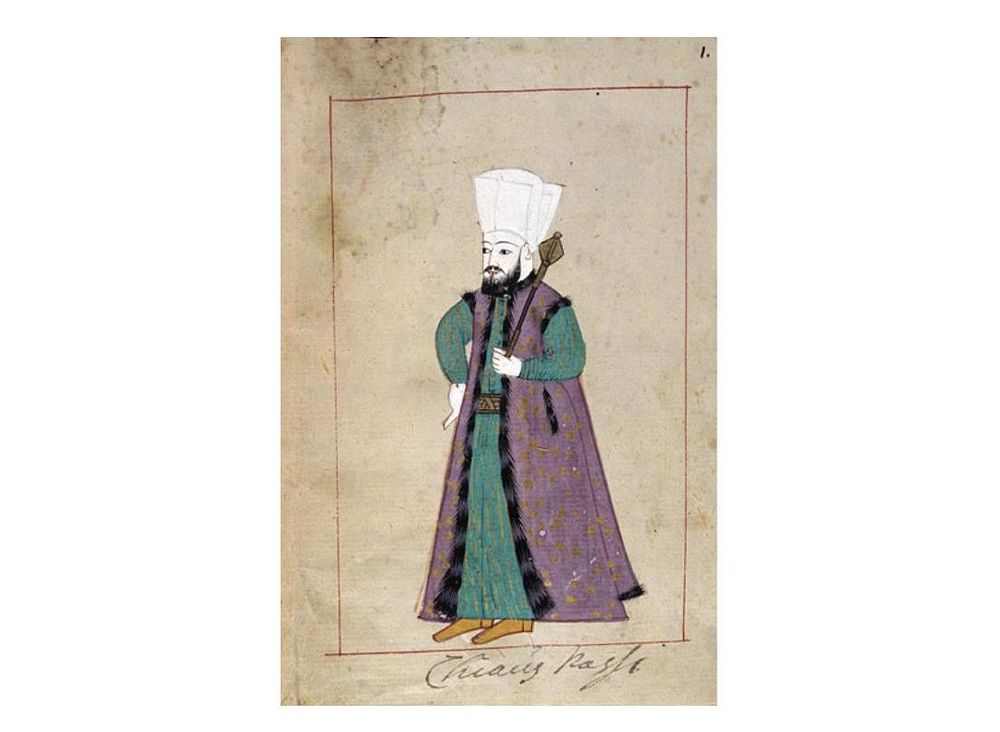
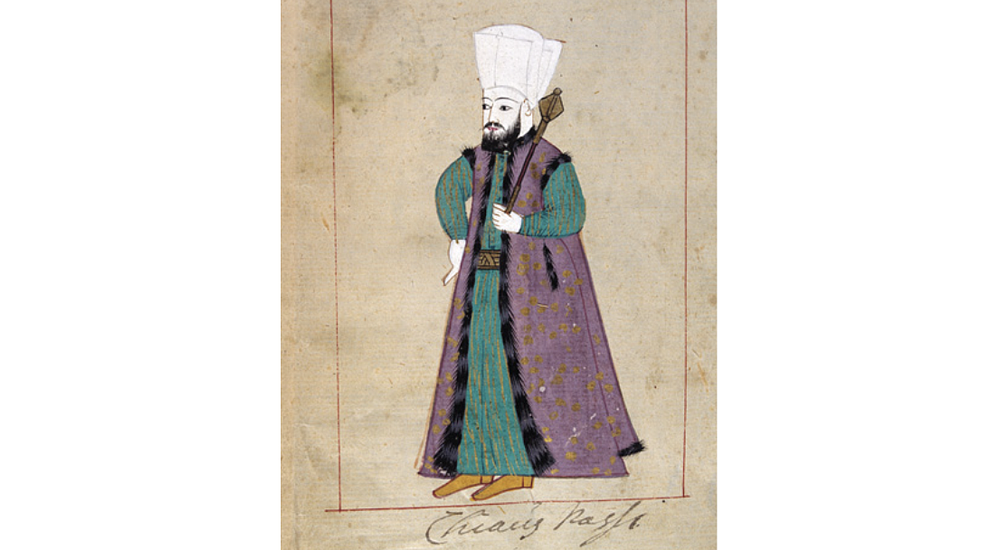
A Chief Çavuş (Çavuşbaşı) of the Ottoman Empire (1657) Pic: Wikipedia (https://tr.wikipedia.org/wiki/%C3%87avu%C5%9Fba%C5%9F%C4%B1 )
From a philological perspective, the historical roots of çavuş appear to extend to early Turkic linguistic traditions. The form çabış, attested in Old Uyghur texts, and the title Chö-pi-shih, reportedly borne by an envoy whom the Tu-Kiu (Göktürk) sent to China in 732 and 735 CE, have been identified as early forms or historical antecedents of çavuş. The word subsequently appears in the form çavuş in Dīwān Lughāt al-Turk (Compendium of the Turkic Dialects), compiled by Mahmud al-Kashgari in the eleventh century, while related forms are recorded as çäüş in Pecheneg and Cuman varieties. These historical and dialectal variants suggest that the term circulated across different Turkic linguistic contexts long before its adoption into English. This deeper etymological background is important because it situates English chiaus within a much longer history of Turkic administrative and diplomatic terminology, rather than treating it solely as a word associated with early modern English representations of Turkish identity.5
The linguistic journey from çavuş to chiaus illustrates the processes through which words moved between cultures during the early modern period. English commercial and diplomatic contact with the Ottoman world facilitated the circulation of unfamiliar administrative terms, which were subsequently adapted to English pronunciation and spelling. Such linguistic exchanges are significant because they demonstrate that early modern English culture was not isolated from the political and institutional realities of the Ottoman Empire. Foreign vocabulary entered English through encounters with people, institutions, and commercial networks. Nevertheless, the incorporation of a foreign word did not guarantee an accurate understanding of its original meaning. Once transferred into a different linguistic and cultural environment, a term could acquire associations shaped by local experiences and popular narratives. The transformation of chiaus is particularly revealing in this respect. A designation associated with Ottoman officialdom became linked in English usage with the act of deceiving another person. The semantic change did not simply translate an Ottoman institution into English; it reinterpreted that institution through a narrative of commercial dishonesty.
“What Do You Think of Me, That I Am a Chiaus?”
Jonson introduces the term during the exchange between Dapper and Face in the opening act of The Alchemist. Dapper, a clerk seeking assistance with a fraudulent scheme involving the supernatural, fears that his dealings might expose him to legal consequences. When Face raises the possibility of discovery, Dapper insists upon his integrity:
“What do you think of me,
That I am a chiaus?”
Face responds, “What’s that?”, prompting Dapper’s explanation: “The Turk was here.” He then clarifies the intended implication by adding, “As one would say, do you think I am a Turk?” (The Alchemist, 1.1). This exchange is constructed around a linguistic misunderstanding that simultaneously reveals the cultural assumptions underlying the joke. Face’s question indicates that chiaus is not necessarily a familiar term to every English speaker. Dapper, however, treats its meaning as sufficiently intelligible to serve as a defence of his own character. His explanation bridges the gap between the unfamiliar Ottoman-derived word and the recognisable cultural category of the Turk. The word becomes meaningful not primarily through an explanation of Ottoman administrative practices but through an appeal to a generalised image of Turkish identity. The rhetorical movement is crucial. Dapper does not merely deny that he is a dishonest official; he asks whether Face takes him for a chiaus and then equates this possibility with being a Turk. The implication is that Turkish identity itself can function as shorthand for deceptive behaviour. Jonson’s comedy thus depends on the audience’s ability to recognise, or at least infer, the negative association that the character invokes. At the same time, the exchange should not be read as a transparent statement of Jonson’s personal beliefs. Dapper’s words belong to a theatrical character operating within a world of manipulation and deception. The scene invites an examination of how cultural stereotypes function within comic language, rather than allowing the character’s assertion to be treated as an uncomplicated authorial judgement. What matters is that the joke becomes theatrically effective through the association between the Ottoman-derived term and the possibility of fraud.
The exchange demonstrates that the word’s cultural intelligibility depends upon its association with Turkish identity rather than upon an explicit reference to Ottoman administrative practices. Read alongside Hakluyt’s earlier usage, Jonson’s passage illuminates the distance between the term’s institutional referent and its pejorative literary connotations. Whereas Hakluyt employs chaus in a diplomatic setting, Jonson mobilises chiaus as a comic marker of dishonesty. The contrast does not, in itself, establish a definitive chronology of semantic change; rather, it reveals how an Ottoman-derived word could carry divergent meanings across different textual and cultural contexts. The term consequently offers a valuable example of the ways in which linguistic borrowing, historical encounter, and the literary construction of the foreign Other intersected in early modern England.
From Diplomatic Office to Commercial Fraud
The semantic transformation of chiaus becomes clearer when considered against the background of Anglo-Ottoman commercial relations. During the late sixteenth and early seventeenth centuries, English merchants developed increasingly important connections with Ottoman territories. The Levant Company, established in 1581, played a central role in organising English trade in the eastern Mediterranean and the Ottoman world. These commercial relationships created opportunities for exchange, but they also exposed merchants to unfamiliar legal systems, diplomatic protocols, and intermediaries whose authority could be difficult to assess. A historical explanation traditionally associated with the word’s development connects its negative meaning with the activities of an individual who claimed diplomatic standing and defrauded merchants. William Gifford, in his nineteenth-century edition of Jonson, connected the term with an intermediary associated with Sir Robert Shirley’s mission to England. According to Gifford’s account, the intermediary defrauded Turkish and Persian merchants of a substantial sum. This explanation has influenced subsequent accounts of the word’s history, although the precise historical details and the causal connection between the incident and the development of the English meaning should be treated cautiously. The World English Historical Dictionary likewise notes that the traditional explanation requires reservation.
Even with this qualification, the historical account offers a valuable framework for understanding the passage. If the negative association developed through a notorious incident involving a purported Ottoman representative, the process illustrates how an individual act of fraud could become attached to a broader cultural designation. The conduct of a particular intermediary was transformed into a linguistic stereotype that extended beyond the individual responsible. This development is important because it reveals a disproportionate relationship between historical experience and cultural representation. The actions of one person could contribute to the formation of a generalised image of Turkish dishonesty. In such a process, the distinction between an individual and the cultural group with which that individual was associated became unstable. The resulting stereotype could circulate independently of the original event, allowing the word to function as a familiar expression even when its historical circumstances were no longer widely understood. Jonson’s comedy captures the literary consequences of this transformation. The word chiaus does not require a Turkish character to appear on stage. Instead, it carries the cultural memory of diplomatic and commercial encounters into a domestic English setting. Its meaning becomes available as a comic resource through which English characters negotiate trust, suspicion, and self-presentation.
The Turk as a Linguistic Shortcut
One of the most significant aspects of Jonson’s passage is the absence of an actual Ottoman representative. The Turk exists in the scene through language alone. Neither Dapper nor Face needs to describe Ottoman institutions, Turkish society, or diplomatic practice in detail. The word chiaus and the explanation “The Turk was here” are sufficient to activate the cultural association on which the joke depends. This absence makes the passage particularly productive for examining the relationship between language and cultural representation. The Ottoman figure is reduced to a linguistic sign that can be invoked to characterise an English subject. Rather than representing Turkish identity through a fully developed character, Jonson allows the idea of the Turk to operate as a ready-made explanation of questionable conduct.
The phrase “The Turk was here” also suggests the lingering presence of an absent figure. The Turk is imagined as someone whose previous visit has left behind a reputation, a suspicion, or a cautionary example. The expression therefore resembles an appeal to collective memory: the audience is invited to understand the reference through an assumed familiarity with the cultural meaning of the word. Yet the joke also exposes a contradiction. Dapper uses the term to distance himself from dishonesty, but the effectiveness of his defence depends on the existence of a stereotype that identifies the Turk with dishonest behaviour. He attempts to establish his own respectability by invoking the disreputable figure he claims not to resemble. His self-defence consequently reproduces the very cultural hierarchy that makes the joke possible. The passage thus reveals how stereotypes can function without requiring sustained representations of the people they describe. A single word can condense assumptions about foreignness and morality, allowing those assumptions to circulate through ordinary conversation. In Jonson’s play, chiaus becomes a linguistic shortcut through which the cultural Other is invoked, simplified, and made available for comic purposes.
Theatrical Irony and the Problem of Credibility
The dramatic context adds another dimension to the word’s significance. The Alchemist is a comedy preoccupied with deception, pretended expertise, fabricated identities, and the exploitation of credulous individuals. Face and Subtle manipulate their victims by presenting themselves as figures possessing specialised knowledge and extraordinary powers. Their success depends on the ability to persuade others that appearances correspond to reality. Dapper’s concern about being mistaken for a chiaus therefore belongs to a larger theatrical investigation of credibility. His insistence that he is not a deceiver emerges within a world in which nearly everyone attempts to manipulate someone else. The irony is that a character seeking supernatural assistance in pursuit of his own interests appeals to a distinction between honest and dishonest conduct.
Face subsequently reinforces Dapper’s defence when he tells Subtle, “This is the gentleman, and he is no chiaus.” He repeats the assertion that Dapper is not a chiaus and emphasises that the clerk will reward Subtle generously. The repetition demonstrates how the term can be deployed strategically in a negotiation. It is no longer simply a label describing a category of person; it becomes a rhetorical instrument used to secure cooperation. The irony deepens because Face himself is a professional deceiver. His reassurance is therefore hardly a reliable guarantee of Dapper’s honesty. By using chiaus to distinguish a supposedly trustworthy client from a dishonest intermediary, Face manipulates the same moral vocabulary that structures his own fraudulent activities. The term becomes part of the play’s wider economy of persuasion, in which claims about integrity are themselves instruments of deception. This context prevents the passage from being reduced to an isolated example of anti-Turkish sentiment. The stereotype remains culturally significant, but Jonson places it within a theatrical world in which moral distinctions are repeatedly exposed as unstable. The association between the Turk and fraud is available to the characters, yet the comedy also demonstrates that English characters can embody the very dishonesty they rhetorically attribute to the foreign Other.
Conclusion
Ben Jonson’s use of chiaus in The Alchemist offers a revealing example of how diplomatic vocabulary could acquire new meanings as it circulated through early modern English culture. Originally associated with Ottoman administrative and diplomatic functions, the word became linked in English usage with deception and swindling. Jonson transforms this linguistic development into a comic exchange in which Dapper’s question, “What do you think of me, / That I am a chiaus?”, culminates in the equation of the term with the Turk.
The passage demonstrates how a specific historical designation could become a cultural stereotype through processes of linguistic adaptation and popular association. The Ottoman official is no longer represented primarily through the functions of his office; instead, the word becomes a shorthand for dishonesty. In this transformation, the distinction between an individual’s actions and a broader cultural identity is obscured, allowing a negative association to circulate beyond its particular historical circumstances. At the same time, Jonson’s theatrical context complicates the representation. The term is used by characters whose own conduct is shaped by manipulation, self-interest, and fraud. Its deployment consequently illuminates both the cultural assumptions through which the Ottoman Other was constructed and the unstable moral world of the play itself. Chiaus is significant not simply because it preserves an Ottoman word in English literature, but because it records a transformation in cultural meaning. It demonstrates how international encounters could leave traces in everyday language and how those traces could become vehicles for stereotyping. Through this single term, The Alchemist reveals the close relationship between linguistic exchange, commercial history, theatrical irony, and the construction of the foreign Other in early modern England.
Works Cited
Jonson, Ben. The Alchemist. 1610. Edited by David M. Bevington, Martin Butler, and Ian Donaldson, in The Cambridge Edition of the Works of Ben Jonson, Cambridge University Press, 2012.
Gifford, William, editor. The Works of Ben Jonson. Vol. 4, 1816. Commentary on The Alchemist.
Hakluyt, Richard. The Principal Navigations, Voyages, Traffiques and Discoveries of the English Nation. Vol. 2, George Bishop, Ralph Newberie, and Robert Barker, 1599.
Köprülü, Orhan F. “Çavuş.” TDV İslâm Ansiklopedisi, TDV İslâm Araştırmaları Merkezi, 1993, https://islamansiklopedisi.org.tr/cavus.
Yule, Henry, and Arthur C. Burnell. Hobson-Jobson: A Glossary of Colloquial Anglo-Indian Words and Phrases, and of Kindred Terms. 1886. Entry on “Chiaus.”
World English Historical Dictionary. “Chouse, n.” Historical discussion of the relationship between chiaus and the meaning “cheat” or “swindler.”
