

Kerman Burning
In 1747, the ancient Persian city of Kerman, which had stood as a nexus for trade and travel on the silk road for many centuries, was burning. The city’s population had lived under effective curfew for weeks, those who could had already fled, many after having been stripped of any wealth or possessions. Those who remained were subject to extraordinary taxation on an almost daily basis, backed up with beatings, murders, looting and the burning of houses. The Deputy Governor of the city committed suicide after he had been handed a demand for 10,000 toman, a sum he could never have realistically raised. The author of this wholesale destruction was not a foreign king, raiding army, or rebellion; he was none other than the Shah of Persia himself. Nader Shah, who has gone down in history as “The Napoleon of Persia”, was a brilliant military commander and leader of men, but by 1747 the strains of ruling an empire, exacerbated by malaria and excessive alcohol, had taken their toll. The Shah was subject to fits of violent rage, shocking paranoia and the most barbarous cruelty. Kerman was just the latest victim.
The fall of Kerman was documented in increasingly lurid detail by a young Englishman, Danvers Graves, who had been dispatched to the city in order to buy locally produced wool and copper on the behalf of the East India Company. Instead of overseeing a progression of purchases, investments, payments and other day to day commercial transactions, Graves’ reports to his superiors at Bandar Abbas and Bombay record the fall of the city. The Company’s ‘linguist’ in the city, a local man named Mohammed, had fled the Company’s house early in the occupation, leaving Graves with no interpreter or translator. Shortly after that, the Dutch East India Company’s Armenian broker was beaten to death in front of the Shah, for having claimed the protection of his employers. Graves was a young man, probably still only in his early 20s when his tenure at Kerman began, but he found himself managing a household and staff under the very real threat of extermination. Despite this, his record of the events that took place at Kerman remains lucid and includes one of very few eye-witness accounts of what took place there not long before the assassination of Nader Shah by his own generals. Indeed, Graves provides one of very few physical descriptions of the Shah, who he saw only once after contriving an audience with him by causing a commotion at the entrance to the royal compound.
While Graves’ report is an excellent source for the study of the economic and social situation of Kerman, the Company’s place in the city and the relationships between the Company’s servants and their non-European employees, it is also a very personal account. Despite being couched in the formal language and layout of many similar reports, Graves’ fear and uncertainty come through clearly. He felt his responsibility for his employees and their families very keenly, while his scorn at his translator comes through equally strongly. His desperation to escape warred with his desire to do the right thing, even when this meant putting himself directly in harm’s way. His experience speaks powerfully to the precarious nature of the Company’s presence in Persia, and indeed Asia more generally in the pre-imperial period. Graves was able to use Persian courtly practice, including the presentation of written agreements and petitions between the Shah and the Company to protect himself, but these were entirely contingent on the Shah’s good will and recognition of their validity. In the case of Nader Shah, neither of these were by any means a given certainty, but Graves’ knowledge of these instruments, as well as the appropriate language and behaviour needed for their presentation is notable in its own right. Danvers Graves presents historians of Persia, the Company and wider Eurasian encounter with an interesting first-hand account, not only of the dramatic fall of a city and a Shah, but also of the daily lives and interactions upon which broader Eurasian encounters were based.
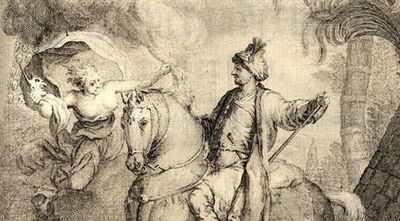
Image: Nader Shah by Jonas Hanway (1753), accessed here

