

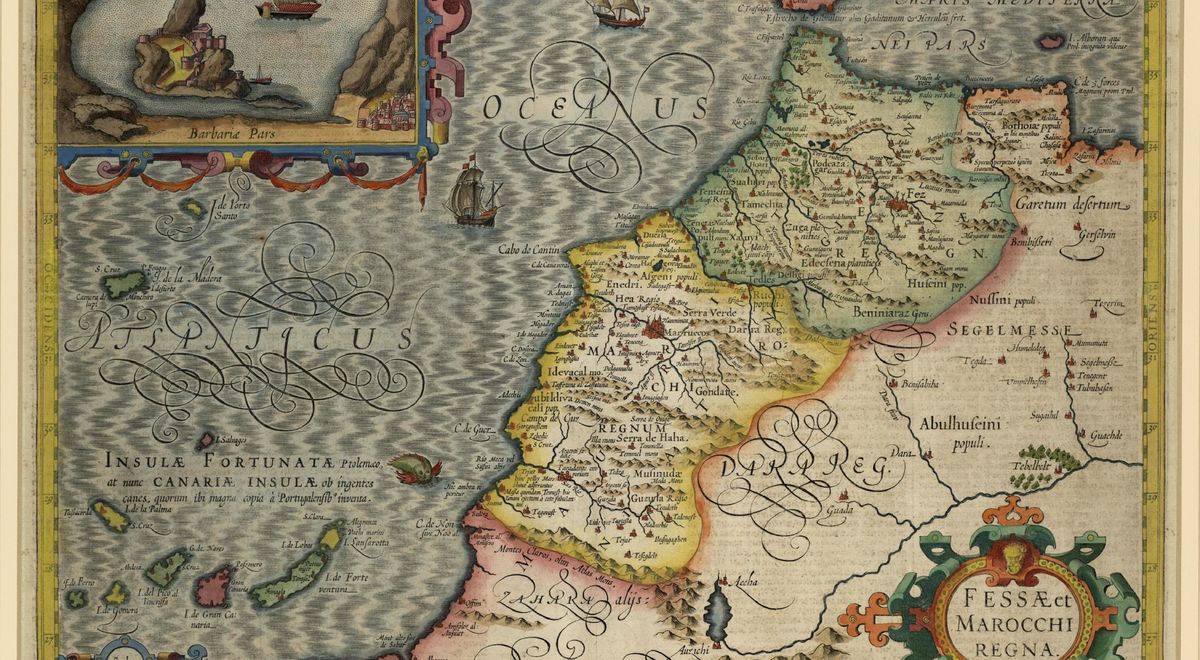
The Ambassador’s Suitcase: The Material Culture of a Spanish Embassy to Morocco (1579)
In this short post, I propose to take a look at an early modern ambassador’s suitcase. In recent years, the material culture of diplomacy has generated growing attention from scholars of cross-cultural relations. Yet, even if investigations of diplomatic encounters between Christian and Muslim powers – Safavid, Ottoman, and Mughal in particular – have emerged in the last few years, the materiality of diplomatic ties between Western Europe and North Africa has remained largely ignored.
My focus is on the material culture of the embassy of Pedro Venegas de Córdoba, a Spanish diplomat sent by Philip II of Spain (d. 1598) to the court of Aḥmad al-Mansūr (d. 1603) in Marrakesh. As a circumscribed example, I concentrate on two kinds of objects brought by Pedro Venegas to Morocco. This will allow me to demonstrate the interest of studying the material culture of ambassadors in the early modern Mediterranean for drafting both political and cultural histories of the region. First, by exploring the nature and reception of the gifts Pedro Venegas brought to the Moroccan court, I demonstrate that late sixteenth-century Morocco was at the centre of competing strategies on the part of neighbouring Mediterranean powers. Second, by focusing on the belongings with which Pedro Venegas travelled– mainly his furniture and dress– I shed light on the material culture of elite travel in the period.
A New Ruler for Morocco
In early August 1578, one year before Pedro Venegas’ journey to Morocco, three kings battled near the town of Qṣar el-Kebīr. The sultan of Morocco, ‘Abd al-Malik fought the deposed sultan Abū Abdallah Moḥammed and his ally, the king of Portugal Sebastian I. In the course of this famous battle that came to be known as the ‘Battle of the Three Kings’, Sebastian was killed – a death that would lead to the unification of Spain and Portugal under the rule of Philip II in 1580. The Moroccan sultans ‘Abd al-Malik and Abū ‘Abdallah Moḥammed also did not survive, paving the way for the ascension of the brother of ‘Abd al-Malik, Aḥmad al-Mansūr, to the throne of Morocco.
After the outcome of the battle was known, several Mediterranean powers sent embassies to al-Mansūr in the hope of forging a stable alliance with the new sovereign. In Spain, two agents were chosen to travel to Marrakesh: Pedro Venegas de Córdoba, a former governor of Melilla (one of Spain’s possessions in northern Morocco) and Diego Marín, an agent who was familiar with North Africa and spoke Arabic. Their mission was clear: establish diplomatic links with al-Mansūr and secure the cession of the port of Larache, coveted by the Spaniards.
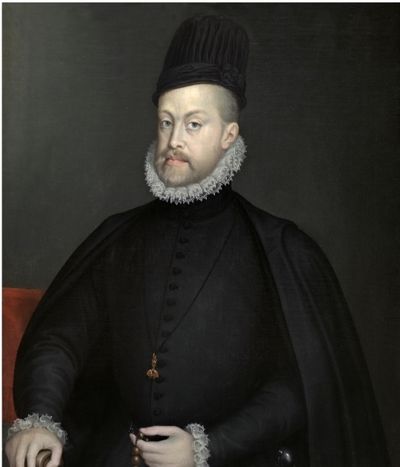
Fig 1: Phillip II of Spain, painted by Sofonisba Anguissola, accessed here
A Regional Gifting Competition
At this point, it is useful to take a detour through the Spanish national archives in Simancas. From the middle of the sixteenth century onwards, the Spanish crown started systematically recording the names of people entering or exiting the crown’s borders with money, precious goods and/or horses. These registers record abundant traces of Pedro Venegas’ journey to Morocco. In early June 1579, the ambassador was authorized to exit Spain, after having declared the list of presents destined to al-Mansūr. The registers indicate that several gold pendants laden with rubies, pearls or emeralds, various types of pearls and stones preserved in small silk pouches, a small chest from the Spanish Indies with a golden rose motif, and several fabrics from the Spanish towns of Valencia and Segovia were to be gifted to the Moroccan ruler.
The abundance and richness of these (global) gifts manufactured both in Spain and across the Spanish Empire were not only a sign of good-will on the part of the Spaniards. On the contrary, they formed part of a fierce regional gifting competition. As soon as they were presented to al-Mansūr, Spanish gifts were compared, weighted and valued against all the objects sent by other Mediterranean powers to the Moroccan court. English informants present at the court of al-Mansūr sent detailed accounts to London of what had been offered and compared it with the gifts sent by the Ottoman Sultan and the King of Portugal. Matias Vanegas, a ship captain who accompanied the Spanish embassy also carefully noted what gifts had been sent from Lisbon and Constantinople in his account of events. From later Moroccan sources, it seems that Moroccan courtiers themselves were well aware of the gifting competition waged for the favours of their ruler. The Moroccan chronicler Moḥammed al-Ifranī (d. 1742), writing more than a century after the event, commented upon Spanish gifts which he compared to the presents sent by the Portuguese, whose reception provoked awe and admiration in the town of Fez.
An Elite Journey Across the Mediterranean and the Atlantic
Beyond shedding light upon geopolitical rivalries that agitated the Western Mediterranean region, the records of Pedro Venegas’ belongings also allow us to (partially) answer an important question: how did (elite) Europeans travel across the Mediterranean (and beyond)? From the inventory of the objects with which he travelled, we learn that Pedro Venegas continuously strove to re-create the comfort he enjoyed at home throughout his Moroccan journey. Before leaving Spain, the ambassador packed a bed and several mattresses as well as assortments of richly decorated covers, blankets and pillows to be used during his itinerance. Anticipating that usual tableware items might not be available in Marrakesh, napkins and tablecloths were also included within his luggage. It is presumably with Spanish forks and napkins that Pedro Venegas and Diego Marín enjoyed the food offered by al-Mansūr upon their arrival to Marrakesh: spices, honey, olives, vinegar and olive oil, assorted jellies, bread, rice, and several live cattle to be killed and prepared by Pedro Venegas’ own cook.
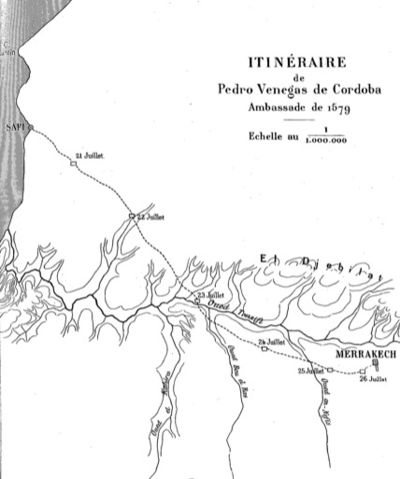
Fig 2: The itinerary of Pedro Venegas’ embassy. Taken from Henri de Castries, Sources Inédites de l’histoire Du Maroc. Archives et Bibliothèques de France. Première Série - Dynastie Saadienne., vol. II (1909), p. 55.
The wardrobe the Spanish ambassador selected to travel to Marrakesh was no less impressive than the furniture he brought: his luggage featured richly embroidered tunics, coats and trousers, as well as no less than six dozen hats and a hundred pairs of shoes. From this list, it is clear that the body of the early modern ambassador mattered: it was through the magnificence of his clothes that Pedro Venegas made the authority of the Spanish King legible in Morocco. In total, according to the writings of Matias Vanegas, no less than thirty-six mules and several camels were necessary to transport all of Pedro Venegas’ belongings from the port of Safi to Marrakesh.
Thus, exploring the material culture of embassies allows us to unearth the links that united early modern courts, from alliance to competition and rivalry. Beyond its usefulness for crafting a political history of the region, however, exploring the suitcases of diplomats also sheds light on the material culture of Mediterranean elite travel, a management of things made out of a permanent tension to embody power, re-create the familiar and adapt to the new.
Title Image: Dutch map of Morocco (1620), accessed here
———————————————————————-
Selected bibliography
For a classic discussion of the material culture of early modern ambassadors, see: Jacobsen, Helen. Luxury and Power: The Material World of the Stuart Diplomat, 1660-1714. Oxford University Press, 2012.
For discussions of early modern diplomatic gifts in various contexts, see: Biedermann, Z. ‘Diplomatic Ivories: Sri Lankan Caskets and the Portuguese-Asian Exchange in the Sixteenth Century’. In Global Gifts: The Material Culture of Diplomacy in Early Modern Eurasia, 88–118. Cambridge University Press, 2017.
Casale, Sinem A. ‘Iconography of the Gift: Diplomacy and Imperial Self-Fashioning at the Ottoman Court’. The Art Bulletin 100, no. 1 (2018): 97–123.
For more information on the relations between Spain and North Africa in the early modern period, see: García-Arenal, Mercedes, and Miguel Angel de Bunes Ibarra. Los españoles y el Norte de África, siglos XV-XVIII. Editorial Mapfre, 1992.
Ana Struillou is a second-year PhD researcher at the EUI’s Department of History and Civilisation. Her doctorate explores the material culture of cross-cultural travel across the early modern Christian and Islamic Mediterranean realm. Her previous research, at Exeter College (Oxford) focused on the material culture of Morisco diplomacy across early modern France and Spain. Her research interests include, amongst others, material culture, mobility and cross-religious relations in the early modern Mediterranean. She tweets @ana_strl