

The Body of a Crusader King: The Relics of Louis IX of France between Tunisia and Sicily
Approximately forty-six years prior to the fall of Acre—the last crusader stronghold in the Near East—to the Mamluk Sultanate, Pope Innocent IV issued the bull, Terra sancta Christi to renew calls for a crusade. King Louis IX of France responded to this call by launching a new crusade against Egypt to push forward to Jerusalem and reclaim the city after its fall in 1187 to Saldin and the Ayyubids. While Louis’s crusade was largely unsuccessful in conquering territory in the Near East, the Eighth Crusade—as its now known—is important as a moment in the history of Louis as a saint and a member of the Capetian royal line in and beyond France.[1] In the years following his 1270 death, Louis’s bones were partitioned between Tunisia, Sicily (Duomo di Monreale), and France (Basilica of Sainte Denis and Basilica of Sainte-Chappelle) by his relatives—primarily, Charles I of Naples (r. 1266-1285)—in order to craft an image of Louis as a saintly king and a crusader.[2]
My most recent blog post on Louis IX’s great-nephew, Louis of Toulouse, and his relics considered the ways in which relics are central to narratives of conquest, colonisation, and empire building in later medieval Europe, particularly in Iberian lands. Like his great-nephew, Louis IX’s relics were similarly used to justify crusade, legitimise Christian rule in southern Italy, and strengthen the beata strips, or saintly lineage, of the Capetian dynasty in France and the Mediterranean. To do so, pieces of his body—fragments of Louis’s skeleton, his heart, and his skull—were split between sites associated with his reign as king (Paris), the kingdom of his brother in southern Italy (Monreale outside of Palermo), and the site of the Seventh Crusade in Tunisia (the relics no longer survive in northern Africa). In splitting Louis’s body between three geographic sites, Philip III (r. 1270-1285) of France, Louis’s son and successor, and Charles I of Naples, Louis’s brother, intended to transform Louis from a French king into a crusader saint associated with conquering territory in the Near East and the broader eastern Mediterranean.
The partition of Louis’s body was not an unusual practice in the Middle Ages. Elizabeth A.R. Brown’s 1981 classic article, “Death and the Human Body in the Later Middle Ages: The Legislation of Boniface VIII on the Division of the Corpse”, discusses the practice of dividing bones and other body parts, mainly of monarchs, nobles, and saints, for religious or political purposes in the high and later Middle Ages.[3] As with saints, for a church, monastery, or political institution to hold a piece of a king—particularly a saintly one—was to be blessed with his connection to the divine and his position as ruler. To dive into this process with Louis of France and his connections to the Mediterranean as a “crusader king”, this blog will begin with the Eighth Crusade (1270) and the efforts by Latin Christians to take control of Egypt and Tunisia.
The Eighth Crusade was the second attempt by King Louis IX to take control of Egypt and Tunisa after the failed Seventh Crusade between 1248 and 1254. To continue to foster an image of himself as a saintly figure, Louis spent time in northern Africa hunting for relics related to the passion of Christ, particularly, the Crown of Thornes, the Holy Lance—an object most famously associated with the First Crusade—, portions of the True Cross, and the Holy Sponge. Throughout the Middle Ages, kings across Europe claimed to own pieces of the passion relics, especially portions of the True Cross. For Louis IX to claim that he found them in Tunisa was not only bolstering his reputation as a crusader, but his standing as a king aiming to become a saint.
By 1270, Louis launched a new crusade to north Africa against the Hafsid dynasty (1229-1574) in his effort to reclaim territory in the Levant. Between 1254 and 1270, Louis sent financial support to new missions to north Africa and western Asia in the hope that Latin forces could reestablish the Kingdom of Jerusalem—a kingdom that had not been in western control since 1187 at the conclusion of the Third Crusade.
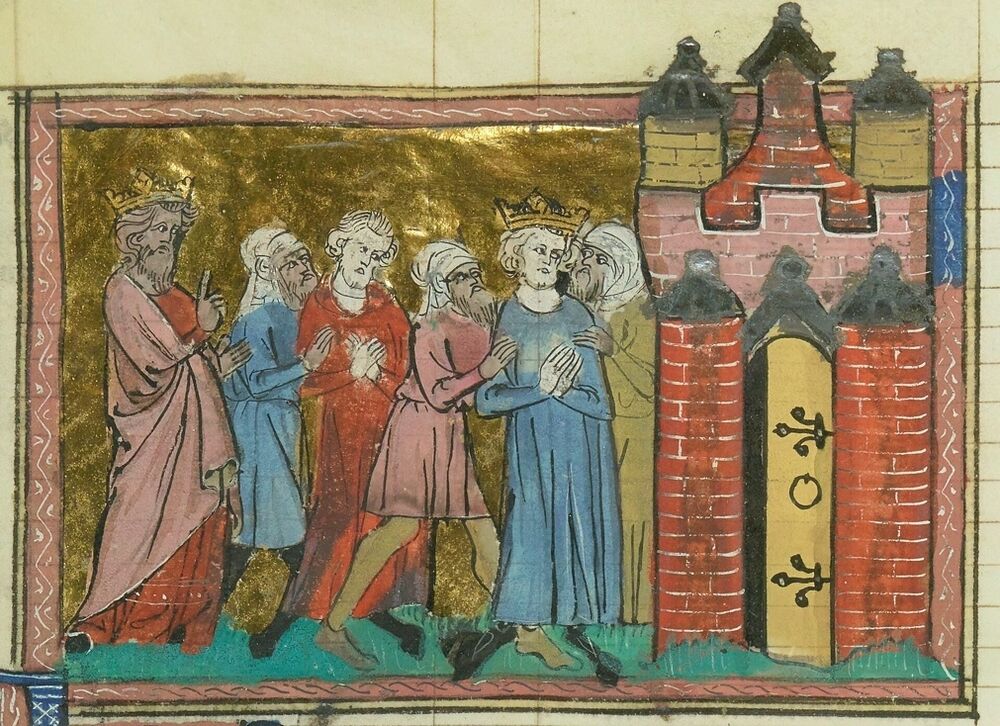
Capture of Louis IX during the Seventh Crusade, 1250.
BnF Français 22495 f.294v. In Open Access on Wikimedia Commons.
Ten years after the conclusion of the Eighth Crusade, Louis’s brother, Charles of Anjou, set his sights on capturing the Kingdom of Sicily (comprised of the modern regions of Campania, Abruzzo, Molise, Puglia, Calabria, Basilicata, southern Lazio, and Sicily). The so-called “Crusade against the Hohenstaufen” was waged by Pope Greogry IX against Holy Roman Emperor and king of Sicily, Frederick II (r. 1198-1250 in Sicily; r. 1220-1250 in the Empire). Frederick’s position as ruler of southern Italy and the Empire—as well as de jure king of Jerusalem through his marriage to Isabella II of Jerusalem—allowed him to unite the two crowns and, essentially, border the Papal States from the north and the south. Along with his failed promises to go on crusade, Frederick was excommunicated and Gregory IX officially called a crusade against him and his heirs. Crusading against Christian kings, nobles, and those deemed heretical was not out of the ordinary in the thirteenth and fourteenth centuries, as the Albigensian Crusade (c. 1209-1229) was waged decades prior against the heretical Cathars in the Languedoc. The crusade against Frederick and his heirs, particularly his sons, Conrad I, Conrad II, and Manfred, permanently ended the reign of the dynasty southern and central Europe.[4]
This crusade led to a new dynastic competition in Europe to decide who would be the next king of Sicily. Ultimately, the brother of Louis IX, Charles of Anjou, was selected by the papacy to finish the crusade by invading Sicily in 1260. Once Charles had successfully been installed as the new king, he focused his efforts on legitimising his reign through his family’s connections to sanctity through Louis and the crusading movement.
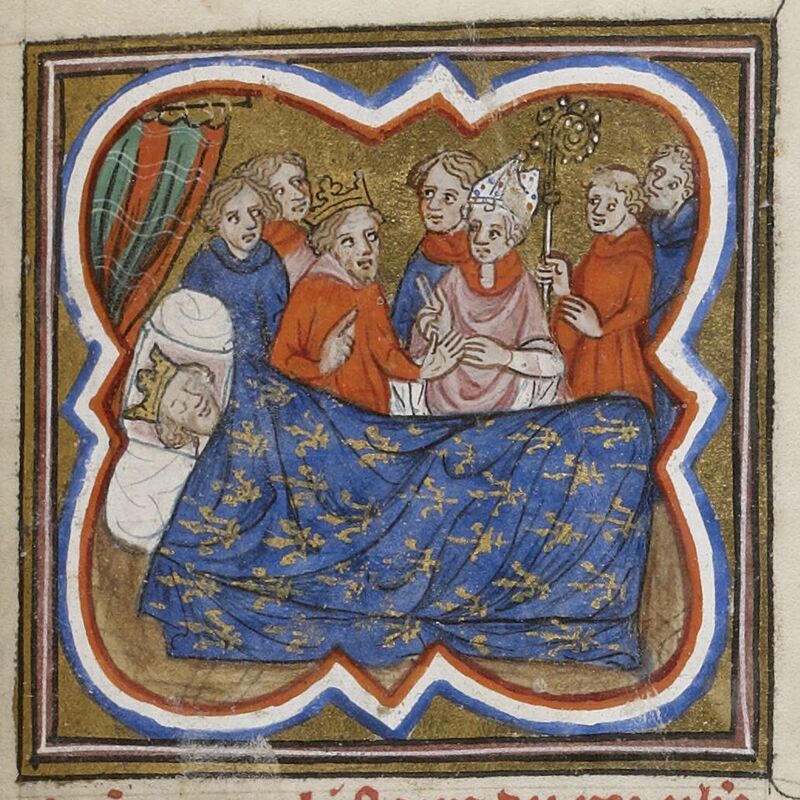
Charles of Anjou at the deathbed of King Louis IX. Biblioteca Nazionale de France, French 10135 f.35 (on Wikimedia Commons in Open Access).
Upon Louis’s death in 1270, his bones, entrails, and heart were dissected and boiled to ensure that they could be moved back to France and buried locally. As Elizabeth A.R. Brown shows in her study of royal and noble dissection, this practice was not uncommon in the Middle Ages. Kings on crusade such as Emperor Frederick Barbarossa (r. 1155-1190)—who famously died in Anatolia enroute to the Third Crusade—had his bones carried to Jerusalem as a holy relic to strengthen morale.[5] Louis’s own death on crusade allowed for Charles of Anjou to take advantage of the connection to Christ and crusading that his brother’s relics would provide.
Immediately following his death, Louis’s bones and flesh were split between France, Sicily, and Tunisa. In the ancient city of Carthage, portions of Louis’s remaining flesh were buried inside a marked grave to commemorate the Eighth Crusade and serve as a shrine to Louis and his growing cult. While Louis was not officially canonised until 1297, these early monuments and depositories for his relics served as the first major pilgrimage sites associated with Louis—which in 2026, now includes the Basilica of Saint Louis in Carthage and the Church of Saint Louis in Rome. Until the construction of the Basilica in 1890, Louis’s relics remained buried in their original site (which is now unknown). Modern visitors to the church can view Louis’s relics—along with other artifacts associated with the king and his cult—as one of the major sites of his cult and, in many ways, a continued symbol of French colonialism in modern Tunisa.[6]
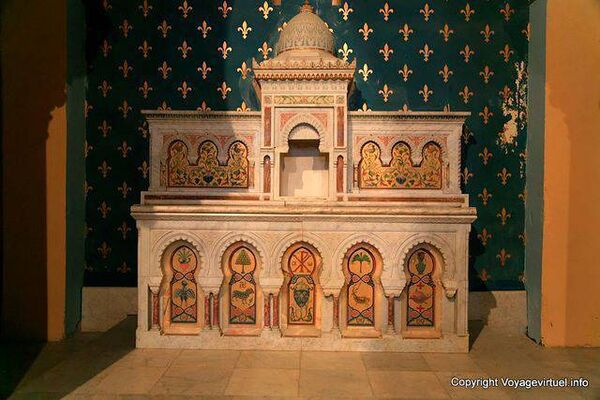
Reliquary altar of Saint Louis in Carthage, Tunisa—now housed in the Basilica of Saint Louis (Source: Voyagevirtual.info).
Following the burial of some of Louis’s bones in Tunisa, his heart and entrails were interned on the orders of Charles of Anjou in Monreale Cathedral in 1270. For a ruler like Charles who was a new king of an established kingdom, having the body of the king of France, particularly one associated with crusading, offered both the legitimacy associated with the Capetian dynasty’s beata strips and the connection to a pious king on his way to sainthood. In the decades following the arrival of his heart and entrails in 1270, the Angevin dynasty of Sicily continued to build its connections to saints in its royal house, most famously, Louis of Toulouse (d. 1297). He was a saint whose own relics dramatically shaped the history of the Crown of Aragon, which you can read about in my previous blog here.
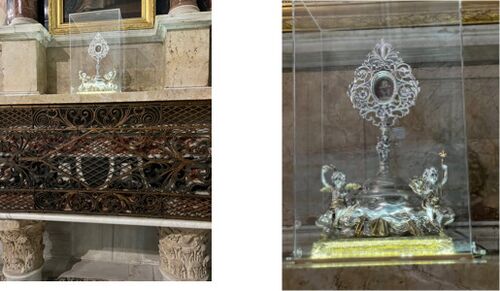
The heart and entrails relics of Louis IX in Monreale Cathedral in Palermo. The left is the heart interned inside a casket and the right shows a small fragment of bone. (Taken by the author, June 2024).
In sum, the circulation of Louis IX’s relics around the Mediterranean world in the late thirteenth century reflect a growing interest in the circulation of body parts associated with saints and kings for political legitimacy. For crusader kings like Louis IX, this connection to sanctity was rooted in Latin Christian Islamophobia that characterised the crusading movement between 1095 and its conclusion in early modernity. In the territories that Louis IX’s relics spread to—particularly Sicily—anti-Muslim rhetoric and deportation only continued to worsen in the fourteenth and fifteenth centuries as Angevin kings like Charles II of Naples (r. 1285-1309) exiled the kingdom’s Muslim inhabitants from the colony of Lucera in modern Puglia.[7] Therefore, the bones, entrails, and flesh of a king associated with crusader violence and piety in life, became a symbol of Christian expansion, French colonisation (particularly in north Africa), and the legacy of crusading in death.
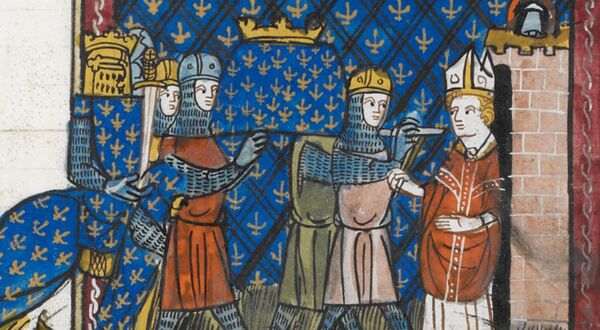
Title Image: Louis IX’s body returning to France from Tunisia on the Eighth Crusade, c. 1270. Source: Wikimedia Commons, British Library, Royal MS 19 D I, fol. 227r (Directorium ad faciendum passagium transmarinum).
[1] For a more comprehensive history of the Seventh Crusade (1248-1254) and documentary sources see, Peter Jackson, ed. and trans., The Seventh Crusade, 1244-1254: Sources and Documents (London: Routledge, 2020).
[2] M. Cecilia Gaposchkin is the authority on Louis IX, his relics, and his cult. To learn more about Louis’s hunt for relics and the circulation of his own body after his death see: M. Cecilia Gaposchkin, "Louis ix and the triumphal cross of Constantine." French Historical Studies 46, no. 1 (2023): 3-35; M. Cecilia Gaposchkin, The Making of Saint Louis (IX) of France: Kingship, Sanctity and Crusade in the Later Middle Ages (Ithaca: Cornell University Press, 2008); M. Cecilia Gaposchkin Blessed Louis, The Most Glorious of Kings: Texts relating to the Cult of Saint Louis of France (South Bend: Notre Dame University Press, 2012).
[3] Elizabeth A.R. Brown, "Death and The Human Body in The Later Middle Ages: The Legislation of Boniface VIII on The Division of The Corpse." Viator 12 (1981): 221-270.
[4] Francesco Migliazzo, “Holy War and Crusade in Southern Italy: Twelfth to Fourteenth Centuries” in Crusading against Christians in the Middle Ages edited by Mike Carr, Nikolaos G. Chrissis, and Gianluca Raccagni (New York: Palgrave, 2024), 55-79; Michelle Hufschmid, "The crusade against the Staufer in Germany, 1246-51” (PhD dissertation: University of Oxford, 2021).
[5] Brown, 227-28.
[6] Daniel E. Coslett, “Monuments, Memories, and Conversion: Commemorating Saint Louis of France in Colonial Carthage.” Journal of the Society of Architectural Historians 82, no. 4 (2023): 420–48.
[7] Julie Taylor, Muslims in Medieval Italy: The Colony at Lucera (Lanham: Lexington Books, 2003).