

The Nawab, the Surgeon, and the Parrot: A Persian Manuscript Between Arcot and Northumbria
Today, manuscript O.60, a copy of the Persian Ṭūṭīnāma (Book of the Parrot), rests in the Oriental Collection of the Hungarian Academy of Sciences in Budapest.[i] This copy, written in 1707 (1119 AH) and comprising 262 folios, contains an English inscription reading: “A Gift from His Excellency Amir ul Umrah Hak: Gift [?]: Emir of all. His Highness, the Nawab to [W]allajah…to Job Bulman”.[ii]
Who was Job Bulman? Why did a South Indian ruler present a Persian manuscript to a European? How did the manuscript travel from South India to a British surgeon and eventually to Budapest? The manuscript’s journey unravels how Persian literary works circulated between South Asian courts, East India Company servants, and European collections during the age of empire.
The Ṭūṭīnāma (Book of the Parrot) belonged to a wider multilingual tradition. That tradition stretched from the Delhi Sultanate to nineteenth-century colonial education in South Asia.[iii] A Persian retelling of a Sanskrit collection of stories known as the Śukasaptati (Seventy Tales of the Parrot), the work crossed linguistic and cultural boundaries long before this manuscript reached the hands of Job Bulman. Under British rule, the Ṭūṭīnāma acquired new meanings as East India Company officials repurposed Persian literary works as tools for language learning and administration. Among those involved in preparing Persian learning materials was Francis Gladwin, a translator and professor of Persian at Fort William College in Bengal.[iv]
Job Bulman was a surgeon from Northumberland who exchanged his native county for the heat of South India, where he served the Nawab of Arcot during the second half of the eighteenth century. The wealth he accumulated overseas left a lasting mark on his home county. His obituary in the Durham County Advertiser of February 1818 recorded that “At his mansion, at Coxlodge, near Newcastle, on Sunday last, aged 74, Job Bulman Esq., one of the partners in the bank of Messrs. Lambton and Co. Newcastle, [passed away].”[v] The heart of modern-day Gosforth developed around what became known as Bulman Village, named after a family whose fortunes became closely intertwined with Britain’s expansion in India. The manuscript thus links an eighteenth-century Persianate court in South India to a community on the opposite side of the globe.
Bulman’s possession of the manuscript, however, was not its destination. It later entered the collection of Sándor Kégl (d. 1920), a Hungarian scholar of Persian studies and an early European translator of Indian Persian poetry. Kégl spent an extended period in Qajar Iran, where he developed contacts with scholars and collectors of Persian manuscripts. Through these later networks, the manuscript eventually entered the Oriental Collection of the Hungarian Academy of Sciences in Budapest. Like Bulman before him, Kégl formed part of another network through which Persian manuscripts travelled across imperial and scholarly worlds.
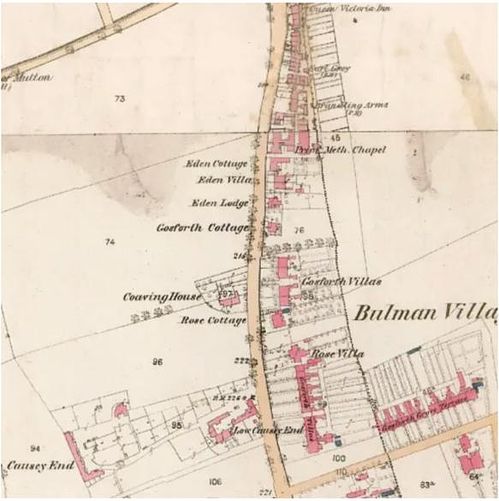
Figure 1. Early map of Bulman Village, Gosforth. Courtesy of Fiona Malkin, “Historical Aspects of Gosforth,” Discovering Heritage.[vi]
Although often overshadowed by better-known centres such as Bengal and Awadh, Arcot was an important centre of Persianate literary culture.[vii] Scholars there debated and imitated the style of the celebrated Persian poet Bēdil (lit. ‘the heartless’, d. 1720), while patrons sponsored the production of Persian and Urdu works in a predominantly Tamil-speaking environment. The Carnatic, the wider region centred on Arcot, had formerly been a Mughal province (ṣūbah) but developed into a largely autonomous state during the eighteenth century. Its rulers cultivated a court that attracted Sufis, merchants, jurists, and poets from across the Persianate world. Such was Arcot’s reputation that it acquired the sobriquet “the little Shahjahanabad” (i.e., Old Delhi), reflecting the influx of Persian- and Urdu-speaking elites from North India, among them Muḥammad ʿAlī Khān Wālājāh himself. Tracing the journey of this copy of the Ṭūṭīnāma offers a rare glimpse into this vivid but often neglected world and the networks that connected it to the expanding British Empire.
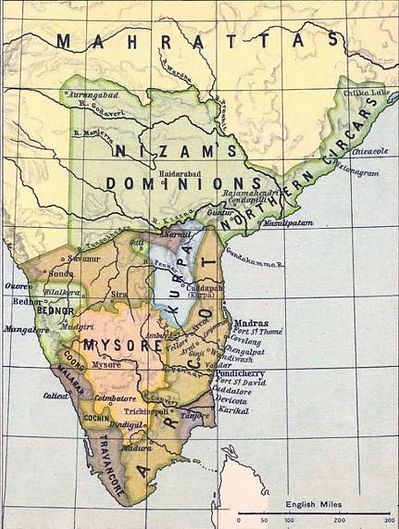
Figure 2. Map of Arcot and the Deccan.
The inscription suggests that the manuscript once belonged to the household of Muḥammad ʿAlī Khān Wālājāh, Nawab of Arcot, before being presented to Job Bulman. The title Amīr al-Umarāʾ, mentioned in the manuscript inscription, likely refers to one of the sons of Muḥammad ʿAlī Khān Wālājāh, who ruled Arcot from 1752 to 1795. Wālājāh emerged as one of the most important allies of the East India Company in South India. His reign and Bulman’s career unfolded during the turbulent decades when South India had become a major theatre of conflict between the French and British East India Companies.
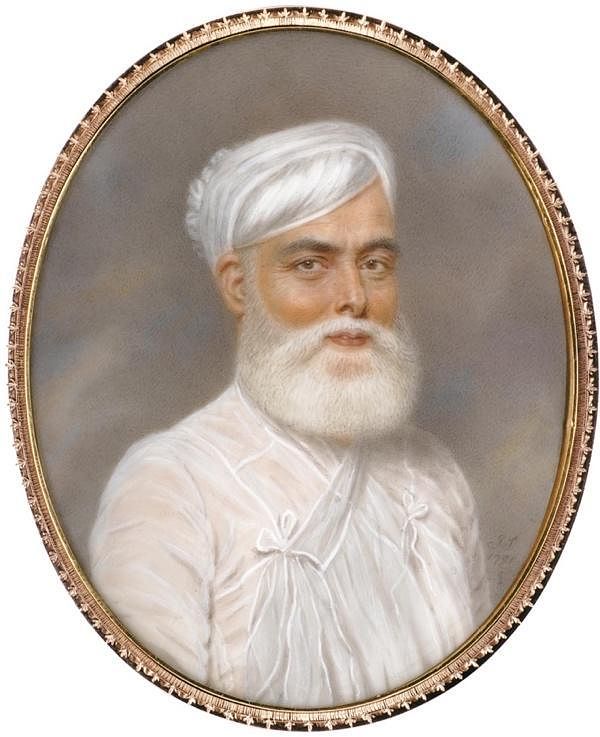
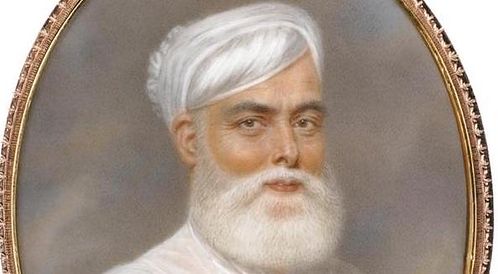
Figure 3. John Smart, Portrait of Muhammad ‘Ali Khan, Nawab of Arcot and Prince of the Carnatic (1718–1795), 1791. Watercolour on ivory. Wikimedia Commons.[viii]
The manuscript’s association with the Wālājāh household is significant because Arcot remained a thriving centre of Persian literary production well into the colonial period. One of the clearest indications of this literary culture is the Tūzuk-i Wālājāhī, a Persian chronicle commissioned by Wālājāh’s son and composed by Munshī Burhān Khān Hānḍī.[ix] Preserving both dynastic history and genealogy, the work offers a glimpse into one of the last major centres of Persianate learning in South India.[x]
Bulman himself served as surgeon to Wālājāh during a turbulent period in South Indian history. By 1780 Bulman had been appointed Surgeon of Madras (today’s Chennai, Tamil Nadu).[xi] His career demonstrates how medical practitioners could become deeply embedded in both South Asian courts and the expanding structures of British colonial power. Through figures such as Bulman, manuscripts like O.60 became entwined in the social and political networks of empire.
Yet relations between the Nawab and the East India Company remained complex and at times strained. Wālājāh sought to boost his position through extensive property acquisitions, while Company officials increasingly viewed his wealth and influence with suspicion. One report by the East India Company’s Select Committee complained that:
“The Nabob is at this time possess’d of one House at Chipauk, one on Choultry Plain, one near the spur, one at Vipary … several at St. Thomé, and several in the Black Town. Three Capital Houses have been purchased in the Fort by Persons in his Service, Viz. one in the Name of Mr. Boswall, one in the name of Mr. Storey, who are both his Surgeons, and one in the Name of Mr. James Johnson…”[xii]
One of the properties mentioned in the report was Chepauk Palace, Wālājāh’s principal residence in Madras and a significant precursor of Indo-Saracenic architecture. Built in 1768, the palace symbolized the Nawab’s close but often uneasy relationship with the East India Company.
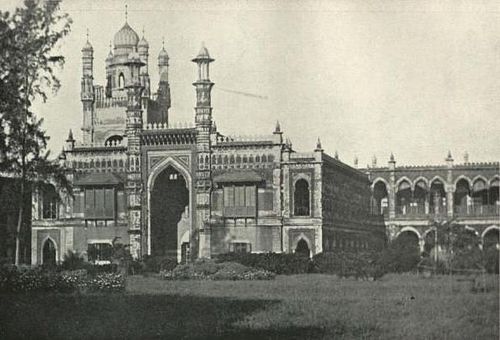
Figure 4. Chepauk Palace, c. 1905. Chennai, Tamil Nadu, India. University of Houston Digital Library.
The palace project encapsulated Wālājāh’s desire for East India Company protection. He initially hoped to construct his residence within the precincts of Fort St George, demonstrating how closely his position depended on Company support. The relocation of the court to Madras in 1766 proved a pivotal moment in the history of Arcot’s Persianate culture. Situated beside Fort St George, the Nawab’s court became increasingly intertwined with the East India Company’s administrative and commercial world. Scholars, secretaries, and literati who had once depended on lavish courtly patronage found new opportunities as teachers of Persian, Urdu, and Arabic for Company officials. Simultaneously, easier access to printers and new reading publics transformed the circulation of Persian texts.[xiii] It was against this backdrop of growing interaction between the court and the Company that manuscripts such as the Ṭūṭīnāma could pass from the Nawab’s household into the hands of European intermediaries like Job Bulman. This growing entanglement came at a considerable price, however. Reliance on Company loans and political support gradually eroded the Nawab’s independence, so that by the early nineteenth century the rulers of Arcot retained little more than their titles while real authority lay with the East India Company.
An editorial note attached to the same report provides an intriguing detail: “In 1778 he [Wālājāh] had eight doctors in his service—viz., two physicians and a surgeon. The former were the Messrs. de Maloa, father and son; the latter were Drs. Robert Storey and Job Bulman, residing on Choultry Plain.”[xiv]
The manuscript shows that Persian books continued to circulate even as political power shifted. It also reveals the overlooked role played by colonial intermediaries, such as surgeons, in moving Persianate objects into European collections.
The parrot who gives the Ṭūṭīnāma its name was meant to tell stories about human nature and relationships. Centuries later, the manuscript itself became a storyteller—carrying with it the voices of Arcot’s court, British India, and the collectors who preserved it. Its journey—from a Persianate court in Arcot, to Northumbria, and ultimately to Hungary—demonstrates how manuscripts, much like people, moved through the interconnected networks of empire.
Dr Kristof Szitar is a lecturer and researcher in Indo-Persian and Urdu. He received his PhD in South Asian Studies from the University of Lausanne and was a Visiting Assistant in Research in Iranian Studies at Yale University. His research focuses on Persianate literary cultures, manuscript and print culture, and the circulation of Persian and Urdu texts across South and Central Asia. His current research examines how the versification of medical knowledge shaped the history of science through the close study of previously overlooked manuscript sources.
References
[i] Iván Szántó, “The Persian and Indo-Persian Manuscripts of Alexander Kégl,” Journal of Islamic Manuscripts 4 (2013): 142.
[ii] MS O.60, fol. 2r, Oriental Collection, Hungarian Academy of Sciences, Budapest.
[iii] Francis Gladwin, The Tooti Nameh; or Tales of a Parrot: In the Persian Language, with an English Translation(London: J. Debrett, 1801).
[iv] P. Thankappan Nair, “Calcutta Pioneers Persian Studies: Francis Gladwin’s Contributions,” Indo-Iranica 4–6, nos. 1–4 (1993): 150.
[v] “Obituary: Job Bulman,” Durham County Advertiser (Durham), February 7, 1818, accessed June 20, 2026, British Newspaper Archive.
[vi] Fiona Malkin, “Historical Aspects of Gosforth.” Discovering Heritage, August 31, 2025.
[vii] On the late Persianate culture of Arcot, see Kevin L. Schwartz, “The Curious Case of Carnatic: The Last Nawab of Arcot (d. 1855) and Persian Literary Culture,” The Indian Economic & Social History Review 53, no. 4 (2016): 533–60.
[viii] Smart, John. Muhammad ʿAli Khan, Nawab of Arcot and Prince of the Carnatic (1718–1795). 1791. Watercolour on ivory. Wikimedia Commons.
[ix] Chandrashekharan, T., ed. Tuzuk-e-Wālājāhi (with Notes). Madras: Government Press, 1957. i–ix.
[x] Chandrashekharan, T., ed. Tuzuk-e-Wālājāhi (with Notes). Madras: Government Press, 1957. 407–408; iii–xl.
[xi] Crawford, D. G., ed. Roll of the Indian Medical Service, 1615–1930. Vol. 1. London: W. Thacker and Co., 1930. 268.
[xii] Love, Henry Davison, ed. Vestiges of Old Madras, 1640–1800: Traced from the East India Company’s Records Preserved at Fort St. George and the India Office, and from Other Sources. Vol. 3. London: John Murray, 1913. 55.
[xiii] Schwartz, Kevin L. Remapping Persian Literary History, 1700–1900. Edinburgh: Edinburgh University Press, 2020. 166–67.
[xiv] Love, Henry Davison, ed. Vestiges of Old Madras, 1640–1800: Traced from the East India Company’s Records Preserved at Fort St. George and the India Office, and from Other Sources. Vol. 3. London: John Murray, 1913. 55.