

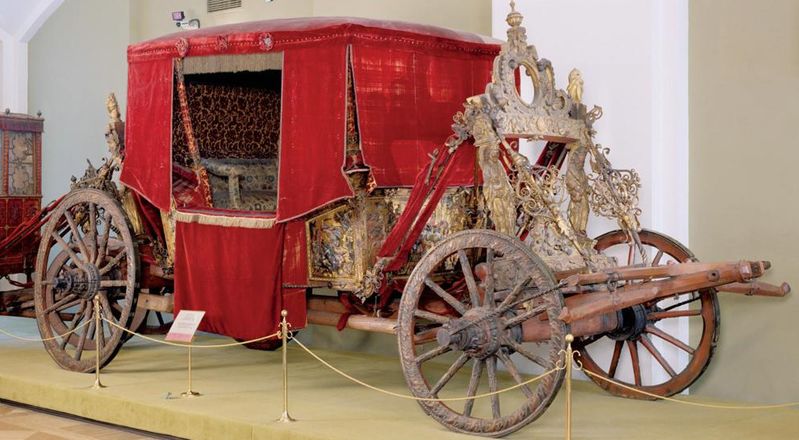
ONLINE SEMINAR: Gift-Giving in Anglo-Muscovite Diplomacy: The English Carriage of 1600
This presentation will be delivered by Dr Tatyana Zhukova (University of York). Alongside the glittering silver-gilt plate, ornamental armour and Russian state regalia preserved at the Kremlin Armoury Chamber in Moscow, a casual visitor to the museum will also find an impressive fleet of royal carriages (as well as a rather extensive collection of horse harnesses and decorations). Dating from the sixteenth to eighteenth centuries, the carriages made their way to Moscow as either diplomatic gifts or royal commissions from agents abroad. One such carriage, a two-seater kolymaga covered in Italian velvet and gilt carved oak panels, was sent to Moscow as a diplomatic gift, most likely in 1604, from James I to Boris Godunov. Godunov (r. 1598-1605) may be more familiar to Western audiences as the titular character of Mussorgsky’s opera based on Pushkin’s 1831 drama in verse Boris Godunov, a Russian response to Shakespeare’s Henry IV.
Although the carriage remains the best-preserved example of its kind, little is known of its history or the role it may have played in fostering Stuart-Godunov relations. Questions abound regarding the identity of its commissioners, the motivations behind its selection (carriages were predominantly associated with female travel), the meanings of its excessively masculine iconography, and the Russian response to its presentation. Contemporary accounts of Muscovy Company merchants emphasised the necessity and importance of lavish gifts for success in trade and diplomacy, and the carriage would have represented a significant financial investment, but did the gamble pay off? This paper proposes to tackle these questions in search of some answers, and in doing so to highlight the central role of gift-giving not only within this specific Stuart-Godunov relationship but Anglo-Muscovite diplomacy in general. After all, gift-giving was its own language, one that united both sides in symbolic communication, but was also a frequent source of misunderstanding and disagreement.