

Book Recommendations from MEMOs August 2022 (No. 24)
Here’s our monthly line-up of fascinating new and forthcoming books which relate to the wider research interests of our team here at MEMOs. If they’re interesting to you too, you can click on the link in the titles to learn more or purchase the books.
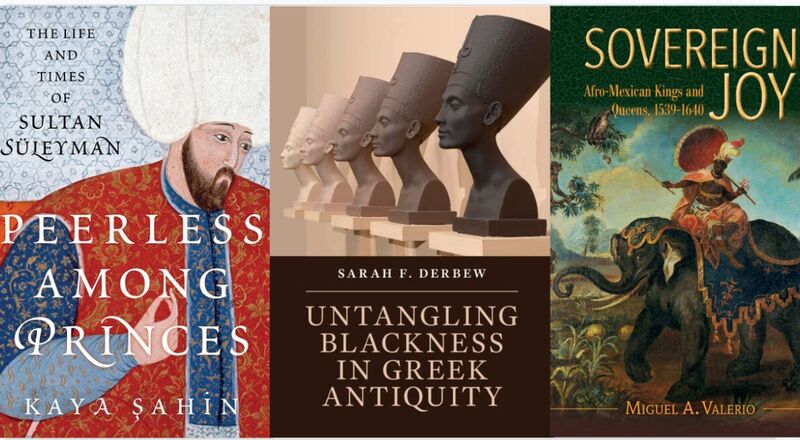
Untangling Blackness in Greek Antiquity, by Sarah F. Derbew
How should articulations of blackness from the fifth century BCE to the twenty-first century be properly read and interpreted? This important and timely new book is the first concerted treatment of black skin color in the Greek literature and visual culture of antiquity. In charting representations in the Hellenic world of black Egyptians, Aithiopians, Indians, and Greeks, Sarah Derbew dexterously disentangles the complex and varied ways in which blackness has been co-produced by ancient authors and artists; their readers, audiences, and viewers; and contemporary scholars. Exploring the precarious hold that race has on skin coloration, the author uncovers the many silences, suppressions, and misappropriations of blackness within modern studies of Greek antiquity. Shaped by performance studies and critical race theory alike, her book maps out an authoritative archaeology of blackness that reappraises its significance. It offers a committedly anti-racist approach to depictions of black people while rejecting simplistic conflations or explanations.
Christians and Muslims in Early Islamic Egypt, ed. by Lajos Berkes
This volume collects studies exploring the relationship of Christians and Muslims in everyday life in Early Islamic Egypt (642–10th c.) focusing mainly, but not exclusively on administrative and social history. The contributions concentrate on the papyrological documentation preserved in Greek, Coptic, and Arabic. By doing so, this book transcends traditional disciplinary boundaries and offers results based on a holistic view of the documentary material. The articles of this volume discuss various aspects of change and continuity from Byzantine to Islamic Egypt and offer also the (re)edition of 23 papyrus documents in Greek, Coptic, and Arabic. The authors provide a showcase of recent papyrological research on this under-studied, but dynamically evolving field.
After an introduction by the editor of the volume that outlines the most important trends and developments of the period, the first two essays shed light on Egypt as part of the Caliphate. The following six articles, the bulk of the volume, deal with the interaction and involvement of the Egyptian population with the new Muslim administrative apparatus. The last three studies of the volume focus on naming practices and language change.
A Monument to Medieval Syrian Book Culture: The Library of Ibn ʿAbd al-Hādī, by Konrad Hirschler
In the late medieval period, manuscripts galore circulated in Middle Eastern libraries. Yet very few book collections have come down to us as such or have left a documentary trail. This book discusses the largest private book collection of the pre-Ottoman Arabic Middle East for which we have both a paper trail and a surviving corpus of the manuscripts that once sat on its shelves: the Ibn ʿAbd al-Hādī Library of Damascus. The book suggests that this library was part of the owner’s symbolic strategy to monumentalise a vanishing world of scholarship bound to his life, family, quarter and home city.
Architecture and Material Politics in the Fifteenth-century Ottoman Empire, by Patricia Blessing
In this book, Patricia Blessing explores the emergence of Ottoman architecture in the fifteenth century and its connection with broader geographical contexts. Analyzing how transregional exchange shaped building practices, she examines how workers from Anatolia, the Mediterranean, the Balkans, and Iran and Central Asia participated in key construction projects. She also demonstrates how drawn, scalable models on paper served as templates for architectural decorations and supplemented collaborations that involved the mobility of workers. Blessing reveals how the creation of centralized workshops led to the emergence of a clearly defined imperial Ottoman style by 1500, when the flexibility and experimentation of the preceding century was levelled. Her book radically transforms our understanding of Ottoman architecture by exposing the diverse and fluid nature of its formative period. It also provides the reader with an understanding of design, planning, and construction processes of a major empire of the Islamic world.
Peerless among Princes: The Life and Times of Sultan Süleyman, by Kaya Şahin
Süleyman, who ruled the Ottoman Empire between 1520 and 1566, was a globally recognized figure during his lifetime. His domain extended from Hungary to Iran, and from the Crimea to North Africa and the Indian Ocean. The wealth of his treasury, the strength of his armies, and his personality were much discussed by historians, poets, courtiers, diplomats and publics across Eurasia. Süleyman was engaged in bitter rivalries with the Catholic Habsburgs in Europe and the Shiite Safavids in the Middle East. He presided over a multilingual and multireligious empire that promised peace and prosperity to its subjects. During his reign, the Ottoman Empire became a truly global power. Imperial governance expanded considerably, and the law was emphasized as the main bond between the ruler and the ruled. Süleyman's prolific poetic output, his frequent appearances during public ceremonies, his charity, and his patronage of arts and architecture enhanced his reputation as a universal ruler with a well-rounded character. Behind the public façade of might and glory, Süleyman led a complicated life. He grew up with an overbearing father whose legacy was both an advantage and a burden. Defying established practice, he married a concubine named Hürrem whose love and affection became a true refuge. Towards the end of his life, he had to overcome both debilitating sickness and the agitations of his sons to remain on the throne. Nearly half a millennium after his death, the life of Süleyman has been obscured by romanticized and exoticized narratives. Based on original sources in multiple languages, Peerless among Princes narrates Süleyman's achievements as well as his failures. What emerges is a compelling account of a ruler, his family, his close associates, and the Ottoman imperial project itself during the transformational sixteenth century.
Sovereign Joy: Afro-Mexican Kings and Queens, 1539-1640, by Miguel A. Valerio
Sovereign Joy explores the performance of festive black kings and queens among Afro-Mexicans between 1539 and 1640. This fascinating study illustrates how the first African and Afro-creole people in colonial Mexico transformed their ancestral culture into a shared identity among Afro-Mexicans, with particular focus on how public festival participation expressed their culture and subjectivities, as well as redefined their colonial condition and social standing. By analyzing this hitherto understudied aspect of Afro-Mexican Catholic confraternities in both literary texts and visual culture, Miguel A. Valerio teases out the deeply ambivalent and contradictory meanings behind these public processions and festivities that often re-inscribed structures of race and hierarchy. Were they markers of Catholic subjecthood, and what sort of corporate structures did they create to project standing and respectability? Sovereign Joy examines many of these possibilities, and in the process highlights the central place occupied by Africans and their descendants in colonial culture. Through performance, Afro-Mexicans affirmed their being: the sovereignty of joy, and the joy of sovereignty.
Shakespeare and Animals: A Dictionary, by Karen Raber and Karen Edwards
This encyclopaedic account of animals in Shakespeare's plays and poems, provides readers with a much-needed resource by which to navigate the recent outpouring of critical and historical work on the topic. This dictionary extends its coverage to include insects, fish and mythic creatures, as well as the places, practices and lore pertaining to all animal-oriented experiences of early modern life. It emphasizes the role of animality in defining character, and is attentive to the instabilities of the human-animal boundary as they were theatrically represented, exploited and interrogated, but it is also concerned with the material presence of animals on stage and in everyday life in Shakespeare's world. The volume is a new tool for instructors, but is also a resource for critics and scholars in the many disciplines engaged with animal studies, posthumanist theory, ecostudies and cultural studies.
Globalizing Fortune on The Early Modern Stage, by Jane Hwang Degenhardt
How were understandings of chance, luck, and fortune affected by early capitalist developments such as the global expansion of English trade and colonial exploration? And how could the recognition that fortune wielded a powerful force in the world be squared with Protestant beliefs about the all-controlling hand of divine providence? Was everything pre-determined, or was there room for chance and human agency? Globalizing Fortune addresses these questions by demonstrating how English economic expansion and global transformation produced a new philosophy of fortune oriented around discerning and optimizing unexpected opportunities. The popular theater played an influential role in dramatizing the new prospects and dangers opened up by nascent global economics and fostering a set of ethical practices for engaging with fortune's unpredictable turns. While largely derided as a sinful, earthly distraction in the Boethian tradition of the Middle Ages, fortune made a comeback on the English Renaissance stage as a force associated with valiant risks, ennobling adventures, and purposeful action. The early modern stage also reveals how a new philosophy of fortune led to economic exploitation and racialized exclusions.
Offering in-depth discussions of plays by Shakespeare, Marlowe, Heywood, Dekker, and others, Globalizing Fortune demonstrates how the history of the English commercial theater—like that of English seaborne expansion—was also a history of fortune. The public theater not only shaped popular understandings of fortune's role in a culture undergoing economic transformation, but also addressed this transformation from a unique position because of its own implication in London commerce, its reliance on paying customers, and its vulnerability to the risks and contingencies of live performance. Drawing attention to an archive of plays dramatizing maritime travel, trade, and adventure, this book shows how the popular stage shaped evolving understandings of fortune by cultivating new viewing practices and mechanisms of theatrical wonder, as well as modeling proper ways of acting in the face of unknown outcomes and contingency. In short, Globalizing Fortune demonstrates how the public theater offered the first modern understanding of fortune as a globalizing commercial and ethical phenomenon.
Blackness and Islam, by Dawud Walid
Muslims speak of Islam in egalitarian terms: the religion of peace, the religion that seeks to elevate man over his base desires, the religion that does not discriminate based on race and ethnicity. Despite the egalitarian spirit of Islam, the lived reality of many Muslims is very different, and this is most apparent when we observe how Muslims deal with race and ethnicity.
Muslims who are Black in the West in particular, have found that while Islam may not discriminate based on race, many Muslims do. To make matters worse, some of those Muslims will delve in to the Islamic tradition to justify their biases and bigotries, seeing no contradiction between their racism and the Islamic ideals. This work seeks to clarify and debunk some traditions which support their racist positions, and presents biographies of early Muslims who were Black. The biographies of these great Muslim personalities shows us how Blackness was a normal part of life for early Muslims, in sharp contradistinction to modern prejudices against Black folks found in some Muslim communities.