

Edith Stedham, Consolessa: An Englishwoman in Ottoman Tunis
This post is adapted from research undergirding my newly-published book Britain and the Ottoman Maghreb, 1662–1712: Merchants, Consuls, and Cultural Exchange (Oxford University Press, 2026). Edith Stedham also appears in the Oxford Dictionary of National Biography.
It’s 10 May 1686, a sunny spring morning at the English consulate in Tunis. Situated by the Bab el Bhar, the medina sea gate, the consulate commands an ideal site for trade. The country has been wracked by civil war for over a decade, but the latest phase seems to have abated. Thomas Goodwyn sits in the courtyard with his intimate partner Edith Stedham, while their six-month-old daughter Urania burbles on a carpet at their feet.[1] A messenger arrives with a packet of letters; the first, from their old friends and partners in London, Francis Barrington and Benjamin Steele, sent all the way back in February. They’ve been waiting for it. Goodwyn opens the letter hastily; he reads it aloud.
It’s a long letter. Barrington and Steele commiserate about the recent disruptions to the wheat trade in Tunis; give instructions and updates about ongoing and proposed ventures in cloth, wire, wool, coffee, rice, shellac, and saltpetre between Tunis, London, Livorno, Cadiz, Alicante, and Alexandria; skate over concerningly shifting partnerships in Livorno and Marseilles; offer a scathing report on their former partner and consul Francis Baker, dissolute and running out of money after returning to London from Tunis; advise Goodwyn on reporting to his governmental superiors at Whitehall; and thank him for his detailed ‘news paper, which is full of the occurances of your plase’.[2]
All useful, all important—for sure! But, for the couple, nothing like so much as Barrington’s postscript.
I have complyed with her orders as to Mr Stedham – In fitting him out for his Voyage to Tunis – with Linnen; Cloths; Hatts; Shoes; Stockins etc.; all which cost £13 7s 9d but after shee hath been att this charge for him; he having heard that the plase is besieged, cryes loth to depart hence; & I believe will [not] aventure thither ‘till he heares of more Prosperity In ye Country – the man it seemes is very chary of his boddy Politick…I thinke itt had been happy for her if shee had taken his forfeiture; for I have been told shee might have done itt; having forfeited ye Bonds of Matrimony by leaving her so many yeares without the least notice or knowledge of his being alive or dead – but slipping ye opportunity shee I feare is like to receive trouble enough from him if once shee should be void of your Protection.
In the words of Tahani al-Jamil of The Good Place:

A Housekeeper-Turned-Merchant
Let’s begin. We know of Stedham entirely through the correspondence and financial records Thomas Goodwyn collected during his residence in Ottoman Tunis (1679-1700), where he worked as a merchant and British consul (1683-1698).[3] Since they lived together when in Tunis, the glimpses are somewhat rare, emerging principally when Goodwyn travelled within Tunisia on business and his colleagues wrote to him directly. However, enough exists to tell a powerful story.
When Stedham arrived, Tunis occupied an unusual position among the Ottoman Maghrebi states. While Britain had spent much of the century at war with Algiers and Tripoli, the treaty with Tunis had held since 1662, making it the most stable—if still precarious—base for British trade in the region. The country remained actively engaged in corsairing against European targets, and the British presence amounted to essentially one small partnership of merchants handling both trade and diplomacy. Internally, things were less settled: since the death of the ruling Bey in 1675, the country had been locked in a damaging civil war between rival claimants to power. It was, in short, a place that rewarded resourcefulness and punished complacency.[4]
By the time Thomas Goodwyn arrived in September 1679, Stedham was already a well-established member of the consular household, and sufficiently respected to send and receive greetings in letters and drink healths to distant colleagues alongside Baker and Barrington (both then resident in Tunis)—courtesies designed to bolster relationships over distance from which servants and apprentices were typically excluded.[5] When Goodwyn led the re-establishment of a grain-trading outpost in regional Cap Négre, Stedham provided for the household’s physical needs with a substantial degree of autonomy: sending to a remote port ‘two bottles of Rosoly, to make amends for the misfortune of the last’[6] and ‘the Shirte you desired’,[7] negotiating (sometimes pointedly) with visiting captains to procure supplies and small presents for their friends,[8] and arranging for bespoke clothing orders across the sea. In October 1683, Francis Barrington (perhaps nervously) wrote to Goodwyn that he had:
by her directions…done what I had no order for – I have laid out for you $89 and is In Stuff Allamode for a Suite with Silke for a Vest & Lyning; with Buttons Ribbons &ca necessary – a Paire of ye new fashioned Stockins & a Paire of English shoes; if yr be any thing done amisse I know who must bare ye blame – I have bespoake you a Paire of Strong Winter shoes; wch I hope you will weare out att Tunis – and nott upon ye rocks.[9]
Though Goodwyn accepted the commission, Barrington remained anxious about the price, and in so doing confirmed their usually high opinion of Stedham’s professional acuity: ‘I feare you will thinke them so deare; as not to hold longer the opinion of Ingallability In Mrs Stedham’s Judgment.’[10]
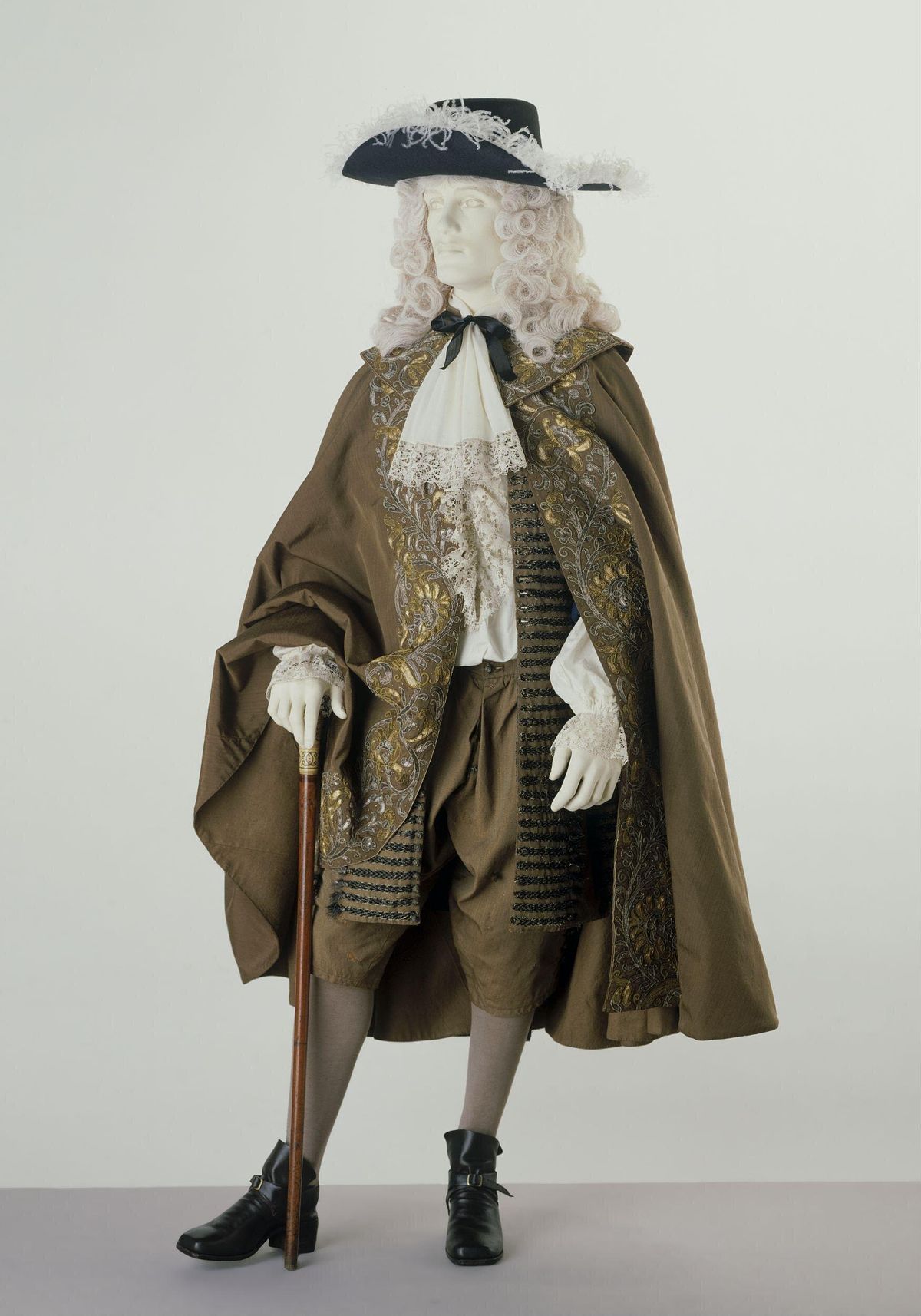
An English worsted suit from the 1680s, Victoria and Albert Museum, https://collections.vam.ac.uk/item/O13921/coat-and-breeches-unknown/.
This opinion was no doubt closely linked to her rising autonomy as a trader. The same year, she had Goodwyn export a quantity of wax to Livorno, considering ‘her selfe much obliged to for your care to procure her some small Profitts from your Station’.[11] An ongoing conflict between Baker, Barrington, and Goodwyn about Baker’s grasping for profits from his consulship further illuminates her boldness, he writing: ‘I look upon them to be matters very improper for her to meddle with … I must have patience; and referre all things to time and reason.[12]
In early 1684, amidst growing tensions in the ongoing Tunisian civil wars, Barrington and Baker left Tunis for London, and Goodwyn and Stedham largely alone, he now as newly-minted consul.
In Her Own Voice
In Tunis, Stedham rapidly became firmly cemented as Goodwyn’s consort. Whether the two were already in an intimate relationship when his partners left is not certain, but if not, they must have pursued it quickly afterwards, since Stedham was pregnant by December. In mid-1685, Goodwyn took another trip to Cap Négre, leaving the pregnant Stedham in charge of their private and official business in Tunis.’[13] Three precious letters are preserved from her to Goodwyn; while written with heavily phonetic spelling that indicates she might have learned to write in adulthood (in one letter, Goodwyn added annotations in pencil to decipher certain particularly difficult passages), in content they reveal an astute and trustworthy businesswoman.[14]
In pursuit of their goals, she engaged with both business clients and political figures in Tunis, Livorno, and Marseilles, sent him public and private news, and discussed his charitable donations and religious convictions.[15] As Robert Lang, the British consul in Marseilles, wrote to her, ‘[I] doe see how that you acte & Correspond in his absence hee is very happy for to have a person soe well quallifyed.’[16]
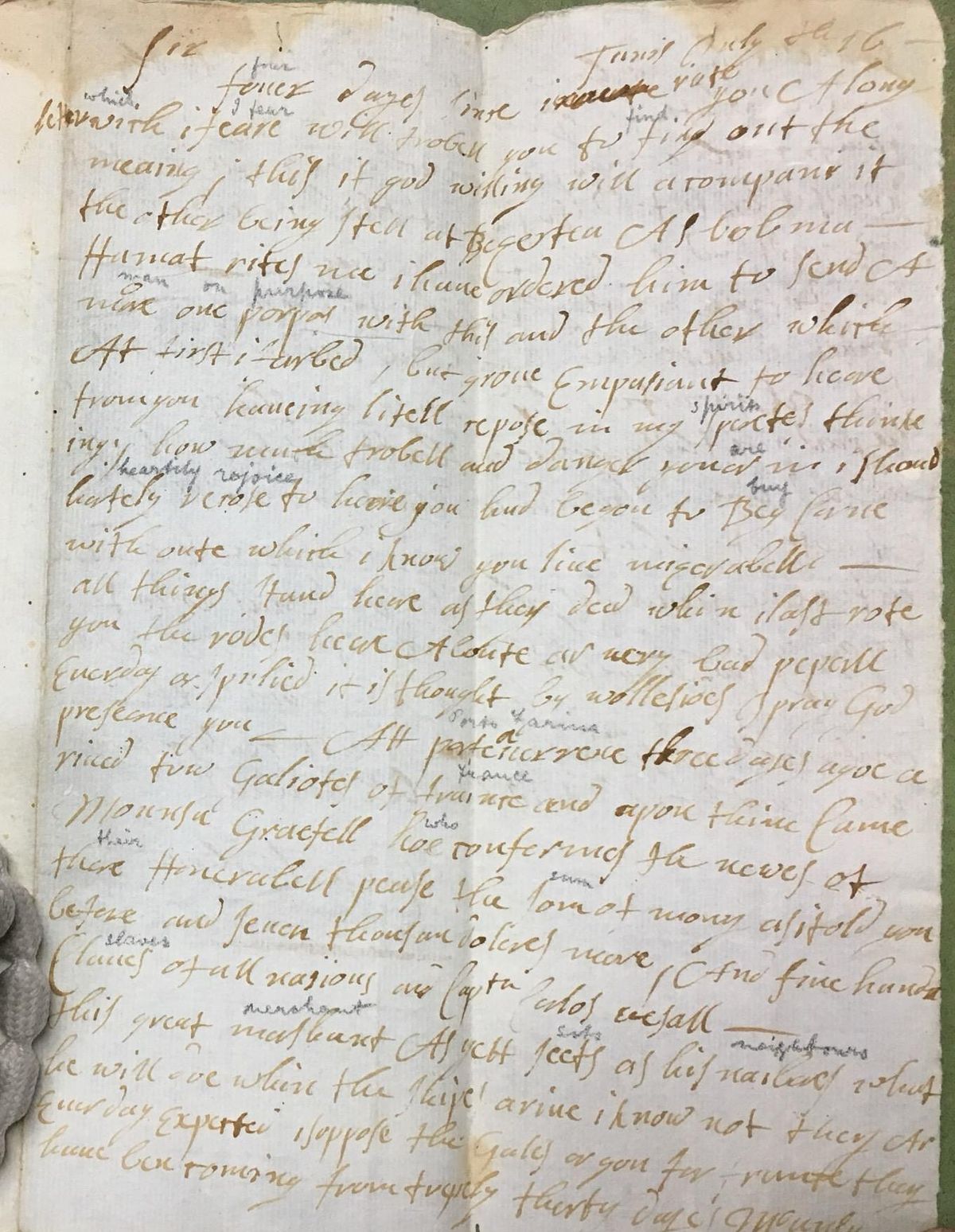
Edith Stedham to Thomas Goodwyn, 16 July 1685, FO 335/5/12, The National Archives, Kew. Note the pencil annotations.
Reporting on a negotiation around cloth with a Muslim colleague Shegrow, she ‘was All most perswaid’ to make a major order in Goodwyn’s name, saying ‘had it benn Amideu Calba or anny bad paymaster i should [not] have veintuered to take it but he being the shouerest taylere in the martket’ it would be prudent to do so.[17] Instead, Stedham focused on more imminent challenges, offering her sanguine reflections on being pregnant and busy dispatching a ship’s cargo in the face of an invading Algerian army:
here the pepell Are very much [frightened] att the Argrenes coming as to my o[w]ne parte am litell Conserned the greater troble swoles up the lifes God doe with me what semeth him good; I hope in a few dayes this shipp will departe for I heartely long to bee Alone my present Condison requires itt
She wryly wrote, knowing the importance of the news she conveyed, ‘i fere i shall to muche trobell you in reading my screbles’, and concluded, ‘I doe promies you to be Astute in and about youre Consearnes as my Capasaty reaches [though] the market is meserabell ded’.[18]
The Greater Trouble
‘Greater troble’ soon proved a grievous understatement. Stedham and Goodwyn’s undoubted joy at welcoming their daughter on 2 September 1685[19] came amidst an onslaught from a multitude of quarters far beyond the civil war that soon abated. In Tripoli, Goodwyn's formerly close friend Thomas Baker — Francis Baker's brother, and the consul who had first lured Goodwyn to the Maghreb — had heard about the relationship and was very displeased:
From an accidentall encounter…of a Person…thoroughly well acquaint’d wth all ye Late Procure there, I shall very unwillingly understand, There has been damn’d foule Play amongst yeew; I speake plurally, pointing to That infamous hipocritical adultresse, against whom aswell as her Protecting Paramours, Who more ready or severe wth their Invectives then your Selfe? Tho’ on your desertion of your first espoused Interest, and profess’t freindship…and falling into more Tempting Alliances you seeme somewhat shie of owning them.[20]
Precisely what Baker thought Stedham had been up to with her ‘Protecting Paramours’ remains unclear—but it sounded the final death knell for Goodwyn and Baker’s relationship, and trouble was brewing in England too. Francis Baker, finding not the warm welcome he had expected on his return home, had become a millstone around the necks of his partners, and blamed both Goodwyn and Stedham, his consolessa. Barrington, writing from London about the embittered Francis Baker, reported:
Consull Baker wee thinke is quite distracted – he now talks of nothing but coming over againe to Tunis wth ye Menn of Warr; finding no adorations from the Generallity of Mankind; wch he fancyed himselfe to have deserved; hath putt the man besides himselfe – he railes att you; calling you Turncoat &ca & MisStedham (who he entitled consolessa) doth not want of his Harangues – blessed be God wee have a large Campagnia; and are not cubb’d up In the same house with him.
However unflattering were Baker’s appellations—consolessa being a lingua franca term for the wife of a consul, though the two were yet unmarried—even worse was to come.
In either July or October 1685, Barrington wrote directly to Edith Stedham to break the news that her estranged husband, whose first name remains unknown, had tracked her down—the husband who had left her at least six years before and never sent a word. Given this shocking news, Stedham’s ‘long silence’ and reliance on her new partner’s protection are hardly surprising. We might think far more about the generosity of response: from her thriving career, and despite her new family, she laid out a sum worth in excess of £2,500 in today’s money to help a man who was not only cowardly (as Barrington’s sarcastic remark about his concern for the ‘boddy Politick’, more his own than that of Tunis, suggests) but—so it transpires—merely hoped to work as a servant under Goodwyn and Stedham’s authority: ‘Mr Stedham saith he will now venture to Tunis—but he seemes of that disposition; as will no waies constitute him a fitt servant for you; either at Tunis or Capo Negro (per aviso)’.[21]
No doubt in the agony of waiting, Stedham did not sit idle: she arranged to re-home a Huguenot apprentice named Henry Serre from near Marseilles in the shadow of the Revocation of the Edict of Nantes, who brought with him a cargo of lead for Stedham’s ‘purposes’[22]; purchased five bolts of fine English violet cloth worth £70 (‘certainely ye best that ever wee yet did see’) for sale in Tunis, with as much or more to be invested elsewhere;[23] with Goodwyn, bought farmland and a fortified farmhouse near Mateur; and showed ‘great kindness’ to Goodwyn’s apprentice Kinard Delabere.[24] By 1689, Urania was old enough to join Goodwyn and Stedham in greetings from visiting captains and expatriates far afield (‘I am much obliged to Madm Stedham & Pretty Urania for their kind Remembrance of me in yor Letter, Please to give them my service & assure them that in ye whole World there is not a Greater Well Wisher to their happiness then I am’).[25]
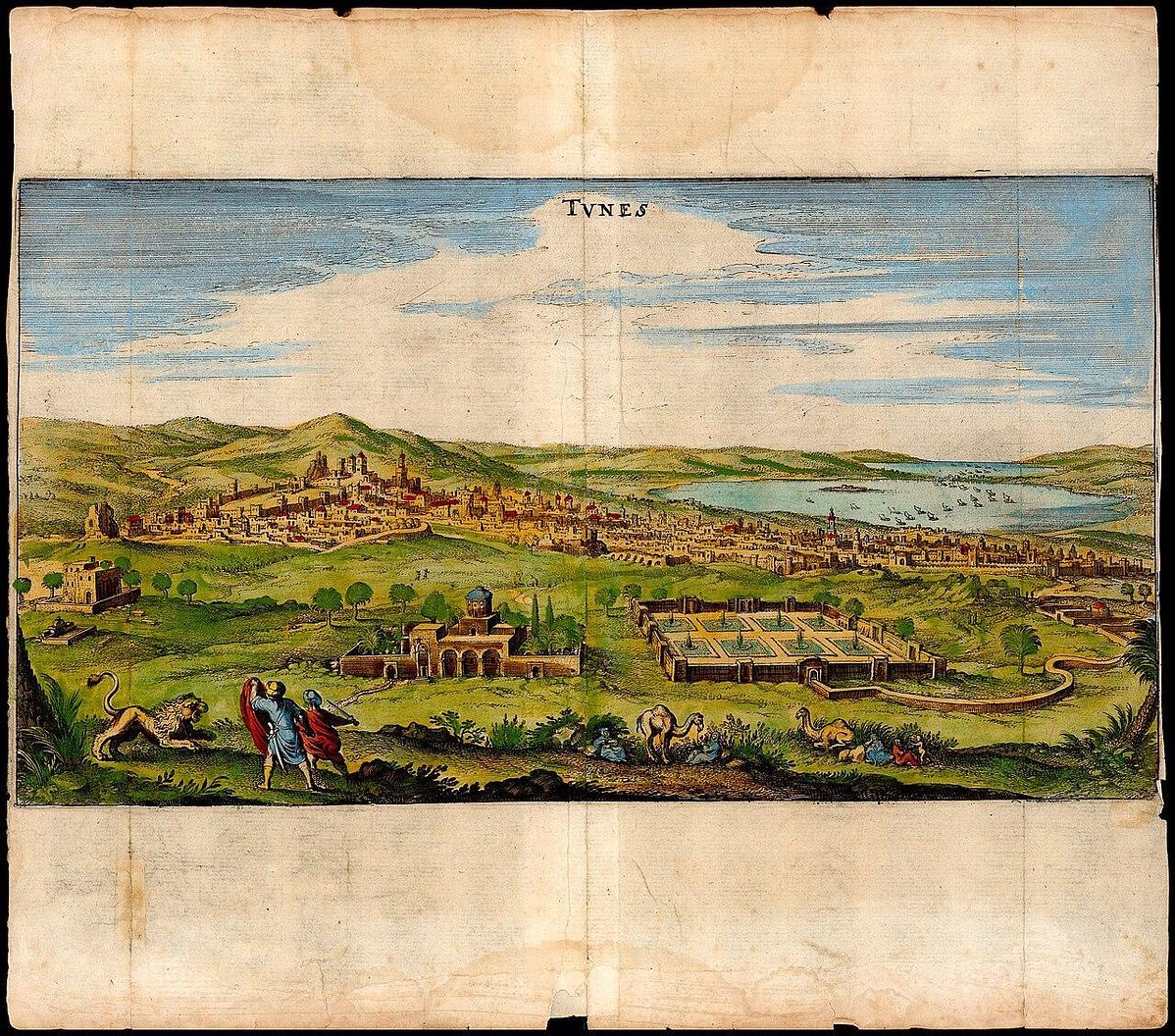
An idealised view of Tunis and the countryside surrounding it. Matthaüs Merian and Johann Angelius von Werdenhagen, ‘Tvnes’, hand-coloured engraving, 1646, https://go.unimelb.edu.au/7zd2.
In the end, Mr Stedham proved just as unreliable has he had been years earlier—Barrington wrote in May 1690 that ‘[her] husband wee have not seen this Twelve month so probably he may have fell amongst the numbers of those that dyed the last yeare att Sea – upwards of 300 died then in his Majty’s Navy’.[26]
Mrs Goodwyn
What she made of this news—which due to the disruptions to Mediterranean transport wrought by the war that might have spelled his end was certainly delayed, perhaps for a year or more—we cannot say, but certainly it made one difference: by January 1693, she and Goodwyn were married, and the fact was known across the sea in Italy.[27] (Tellingly, though Thomas Baker had moved from Tripoli to become consul in Algiers, had his own adulterous affair and illegitimate daughter with a married woman, Deborah Bourne née Robinson, who became his wife shortly after her husband’s death, and enthusiastically arranged Algerian ribbons for Urania, he never greeted Stedham-Goodwyn herself in his letters to Goodwyn.[28])
As a married woman, Stedham-Goodwyn’s economic transactions were now, at a financial level, not distinguished from her husband’s and thus are harder to trace. We know that she continued corresponding personally with their merchant partners abroad, and managed Goodwyn’s too.[29] In 1693-94, she and Urania fled Tunis for Sousse to escape a new phase of the civil wars and despite a virulent outbreak of smallpox in that city, but continued advising her husband on business affairs and closely supervised their partner and colleagues. John Goddard, the captain of the firm’s ship, dishonourably broke open and copied one of her letters to gain intelligence he could exploit; the future consul James Chetwood, commented they were so busy that ‘Mrs G: will hardly ever allow me to write a word & now not a sillable more’; and Goodwyn’s letter to a recalcitrant colleague George Reynolds ‘was detein’d by Mrs Gn & I think twas not amisse, for his discourse and Deportment, in my opinion doe’s not merrit such a Courteous reply’.[30]
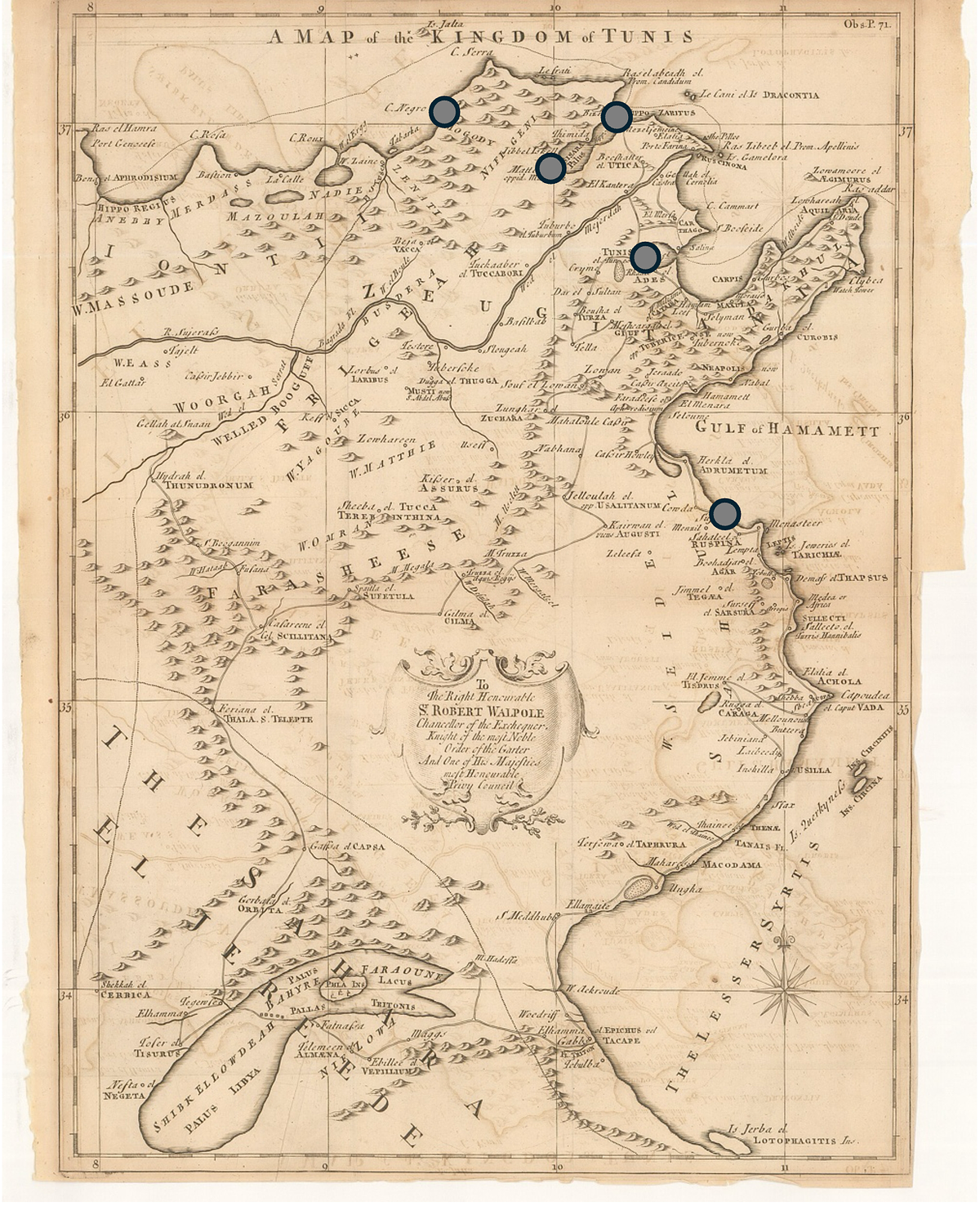
A Map of the Kingdom of Tunis, from Thomas Shaw, Travels, or, observations relating to several parts of Barbary and the Levant (London, 1738). Marked locations are (clockwise from top) Cape Negro, Mateur, Bizerte, Tunis, and Sousse. https://go.unimelb.edu.au/czd2.
But less than a fortnight after this last, she was dead. A sudden illness, first documented on 3 March 1695, spelled her death by the 4th.[31] Her death caused lamentation across not only their household, but with their Muslim colleagues as well. In the words of their Huguenot ward Henry Serre:
am Sorry To ye wery heart of mine to heare of ye Deathe of my Dear mother whome God Almighty as taken away from us, and I doe pray God Almighty to Confort you and Mis Urania Whome God preserve Amen Amen I see that yow were Sorry that I did not wrott you by Domingo but metinkes that hee might tell you in what Conditione I was as itt is Reason having loste such a friend as Shee was to mee more then a mother
Amour Delela present his service to you…hee his Very much Concerne of ye Death of my Dear mistrese and soe his all our freinds here Kisseing your hands[32]
The news travelled widely—to ship’s captains, the Dutch and Hanse consul in Marseilles, who sent Goodwyn a black hat and stockings for mourning; the British consul in Tripoli; and finally their partners in London.[33]
Conclusion
Stedham's story is striking on its own terms: an abandoned wife who forged a new life far from home and, in the process, established what was almost certainly the first freeborn English-speaking family in the Ottoman Maghreb. The range of her movement — visiting captains in port, negotiating with Tunisian tailors, commissioning suits and linens across the Mediterranean, running the consulate in her husband's absence while eight months pregnant — stands in stark contrast both to her Tunisian contemporaries and nineteenth-century successors who largely stayed within their houses and consulates.[34] The Bakers' sneers about her "hypocritical" conduct and her "Protecting Paramours" are, in their way, backhanded acknowledgements of precisely this: like Linda Colley’s Elizabeth Marsh, her life in a foreign land allowed to her move beyond conservative notions of a woman’s role to become powerful enough to be worth slandering.[35]
This matters because the field has long leaned toward a narrower frame. Many scholars have argued that the British women who achieved real influence in early modern Islamicate societies typically did so as captives, by converting to Islam and marrying powerful local men. These were remarkable trajectories, but they were not the only ones available. Stedham shows that a free British woman — retaining her language, her Christian identity, and her place in an English-speaking commercial community — could also wield genuine influence in Ottoman Tunis, not despite those continuities but through them.[36] And she wasn’t alone. If, as some argue, we can measure the strength of British-Maghrebi relations by the presence of British women, Stedham and her contemporaries Jane Lodington and Deborah Baker embody an shift towards cooperative and peaceful British-Maghrebi relations far earlier than many suspect.[37] More importantly, like Stedham, these British women actively shaped the mercantile and diplomatic activities that linked the Maghreb to Britain and the wider Mediterranean world. Their stories should make us rethink the captivity-and-corsairs story that still dominates popular and scholarly memory. Stedham did not live to see that shift mature: she was among the first to make it possible.
Next time, we’ll take the story on, through the experiences of Stedham’s and Goodwyn’s daughter Urania: how a grieving, doting father and his merchant partner, a succession of substitute mother-figures, and a hybridised Anglo-Maghrebi childhood shaped the young woman a suitor would one day call ‘the Incomparable Urania’—and who would eventually return to London as the heiress to a Tunis-based fortune.
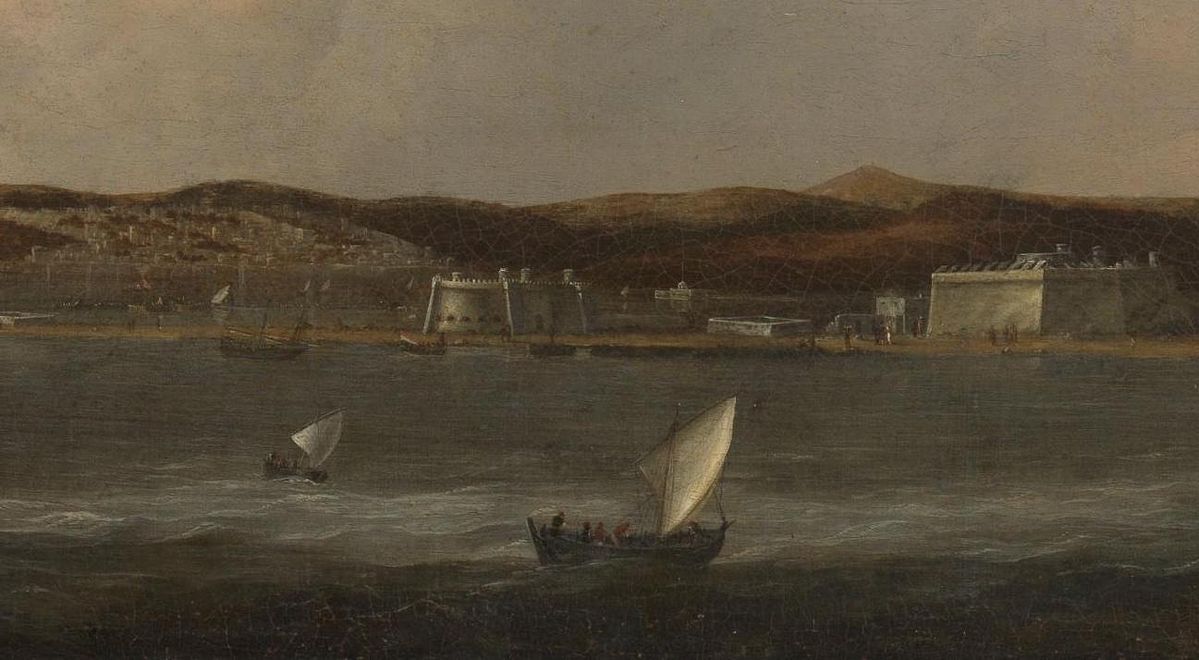
Title Image: Reinier Nooms, ‘View of Tunis’, c.1662-68, oil on canvas, Rijksmuseum Amsterdam, https://www.rijksmuseum.nl/en/collection/SK-A-1397/catalogue-entry
[1] On the structure of the British consulate, see Nat Cutter, Britain and the Ottoman Maghreb, 1662-1712: Merchants, Consuls, and Cultural Exchange (Oxford University Press, 2026), 110-11.
[2] See Cutter, Britain and the Ottoman Maghreb, 174-80; Nat Cutter, ‘Grateful fresh advices and random dark relations: Maghrebi news and experiences in English expatriate letters, 1660-1710’, Cultural and Social History 19, 4 (2022): 425-444.
[3] These materials are central to my book; a biography of Goodwyn is available from Oxford Dictionary of Biography as well: https://www.oxforddnb.com/display/10.1093/odnb/9780198614128.001.0001/odnb-9780198614128-e-90000380754.
[4] Cutter, Britain and the Ottoman Maghreb, 14-15.
[5] Francis Baker to Thomas Goodwyn, 30 July 1679, FO 335/1/33, 21 March 1681, FO 335/2/10, repeatedly in February-April 1682, FO 335/3/1; Walter Beavan to Thomas Goodwyn, 10 October 1681, FO 335/2/9; Francis Barrington to Thomas Goodwyn, 23 January 1682, FO 335/3/3; Thomas Baker to Thomas Goodwyn, 16 May 1682, FO 335/3/2; Thomas Baker to Thomas Goodwyn, 16 May 1682, 5 October 1682, FO 335/3/2, 15 January 1683, 20 April 1683, FO 335/3/10; Francis Barrington to Thomas Goodwyn and Richard Russelman, 18 July 1683, FO 335/3/8. These practices continue throughout her life.
[6] Francis Baker to Thomas Goodwyn, 5 April 1682, FO 335/3/1.
[7] Francis Baker to Thomas Goodwyn, 27 May 1682, FO 335/3/1.
[8] Francis Baker and Francis Barrington to Thomas Goodwyn and Richard Russelman, 25 September 1683, FO 335/3/9; Francis Barrington to Thomas Goodwyn, 29 September 1683, FO 335/3/9.
[9] Francis Barrington to Thomas Goodwyn, 2 October 1683, 18 October 1683, FO 335/3/9.
[10] Ingallability = the inability to be gulled, i.e. the opposite of gullible. Francis Barrington to Thomas Goodwyn, 2 November 1683, FO 335/3/9. Shortly after, Stedham arranged to clothe Goodwyn’s nephew and apprentice William Newark: ‘herewith goes; a slovenly Suite both for shape & quallity; a Paire of Shoes &ca … Mrs Stedham is making him up a better suite to appeare In att Tunis; she kindly salutes you; but is mightly Indisposed with a Cold’. Francis Barrington to Thomas Goodwyn, 2 November 1683, FO 335/3/9, 15 November 1683, FO 335/3/9.
[11] Francis Barrington to Thomas Goodwyn, 22 September 1683, 2 October 1683, 24 October 1683, FO 335/3/9.
[12] Francis Baker to Thomas Goodwyn, 1 August 1683, FO 335/3/8.
[13] Robert Lang to ES, 28.08.1685, FO335/5/9. See Robert Skeele to ES, 26.08.1685, FO335/5/11.
[14] Edith Stedham to Thomas Goodwyn, 20 June 1685, 12 July 1685, 16 July 1685, FO 335/5/12.
[15] On the latter, see William Blacklock to Thomas Goodwyn with annotations by Edith Stedham, 10 August 1685, FO 335/4/14.
[16] Robert Lang to Edith Stedham, 28 August 1685, FO 335/5/9. See Robert Skeele to Edith Stedham, 26 August 1685, FO 335/5/11.
[17] Edith Stedham to Thomas Goodwyn, 12 July 1685, FO 335/5/12.
[18] Edith Stedham to Thomas Goodwyn, 12 July 1685, 16 July 1685, FO 335/5/12.
[19] James Chetwood to Thomas Goodwyn, 2 September 1697, FO 335/12/4.
[20] Thomas Baker to Thomas Goodwyn, 31 May 1685, FO 335/5/4.
[21] Francis Barrington and Benjamin Steele to Thomas Goodwyn, 8 March 1686, FO 335/5/16.
[22] Edith Stedham to Thomas Goodwyn, 20 June 1685, FO 335/5/12; Robert Lang to Edith Stedham, 26 September 1684, FO 335/4/9, 28 August 1685, 28-30 August 1685, FO 335/5/9.
[23] Francis Barrington and Benjamin Steele to Thomas Goodwyn, 4 November 1686, FO 335/5/16, 10-14 January 1687, 10 February 1687, FO 335/6/6.
[24] Thomas Goodwyn to Kinard Delabere, 13 August 1688, 16 August 1688, FO 335/15/2; Kinard Delabere to Thomas Goodwyn, 21 August 1690, FO 335/8/12.
[25] Lawrence Wise to Thomas Goodwyn, 4 November 1689, December 1689, FO 335/7/11, 19-28 April 1690, FO 335/8/6; Thomas Garris to Thomas Goodwyn, 15 July 1689, FO 335/7/11, 27 February 1690, FO 335/8/7.
[26] Francis Barrington and Benjamin Steele to Thomas Goodwyn and Kinard Delabere, 24 April-22 May 1690, FO 335/8/9.
[27] James Chetwood to Pheobe Haye, 2 January 1693, FO 335/15/6.
[28] Thomas Baker to Thomas Goodwyn, 10 July 1692, FO 335/9/10, 24 June 1693, FO 335/10/6. See Cutter, Britain and the Ottoman Maghreb, 90-92.
[29] James Chetwood to Thomas Goodwyn, 18 June 1692, FO 335/9/9, 10 November 1692, 29 November-6 December 1692 FO 335/9/11; Francis Barrington to Thomas Goodwyn, 1 October 1692, FO 335/9/13.
[30] Benjamin Lodington to Thomas Goodwyn, 21-31 August 1693, FO 335/10/7; James Chetwood to Thomas Goodwyn, 2 November 1693, FO 335/10/8, 30 September 1694, 12 October 1694, FO 335/10/14, 12 February 1695, FO 335/11/5; John Goddard to Thomas Goodwyn, 22 August 1694, FO 335/10/14.
[31] James Chetwood to Thomas Goodwyn, 3 March 1695, 5 March 1695, FO 335/11/5; Henry Serré to Thomas Goodwyn, 8 March 1695, FO 335/11/5.
[32] Henry Serre to Thomas Goodwyn, 8 March 1695, FO 335/11/5.
[33] Henry Durtie to Thomas Goodwyn, 27 March 1695, FO 335/10/12; Tobias Sollicoffre and Mr. Alphusuis, 7 April 1695, FO 335/11/3; Benjamin Lodington to Thomas Goodwyn, 21 May 1695, FO 335/11/3; Francis Barrington and Benjamin Steele to Thomas Goodwyn, 14 June 1695, FO 335/11/3.
[34] Julia Clancy-Smith, Mediterraneans: North Africa and Europe in an Age of Migration, c. 1800-1900 (University of California Press, 2011), 38.
[35] Linda Colley, The Ordeal of Elizabeth Marsh: A Woman in World History (Pantheon, 2007), 205.
[36] Nabil Matar, Britain and Barbary, 1589-1689 (University of Florida Press, 2005), 92-110; Bernard Capp, British Slaves and Barbary Corsairs, 1580-1750 (Oxford University Press, 2022), 56-62; Khalid Bekkaoui, ‘Piracy, diplomacy, and cultural circulations in the Mediterranean’, in Piracy and Captivity in the Mediterranean, 1550-1810, edited by Mario Klarer (Routledge, 2019), 191-93.
[37] Gerald MacLean and Nabil Matar, Britain and the Islamic World, 1558-1713 (Oxford University Press, 2011), 97-99; Cutter, Britain and the Ottoman Maghreb, 101-2.
