

Fit for a Princess: Connecting Britain and the ‘Moluccas’ in 1621 and 2011
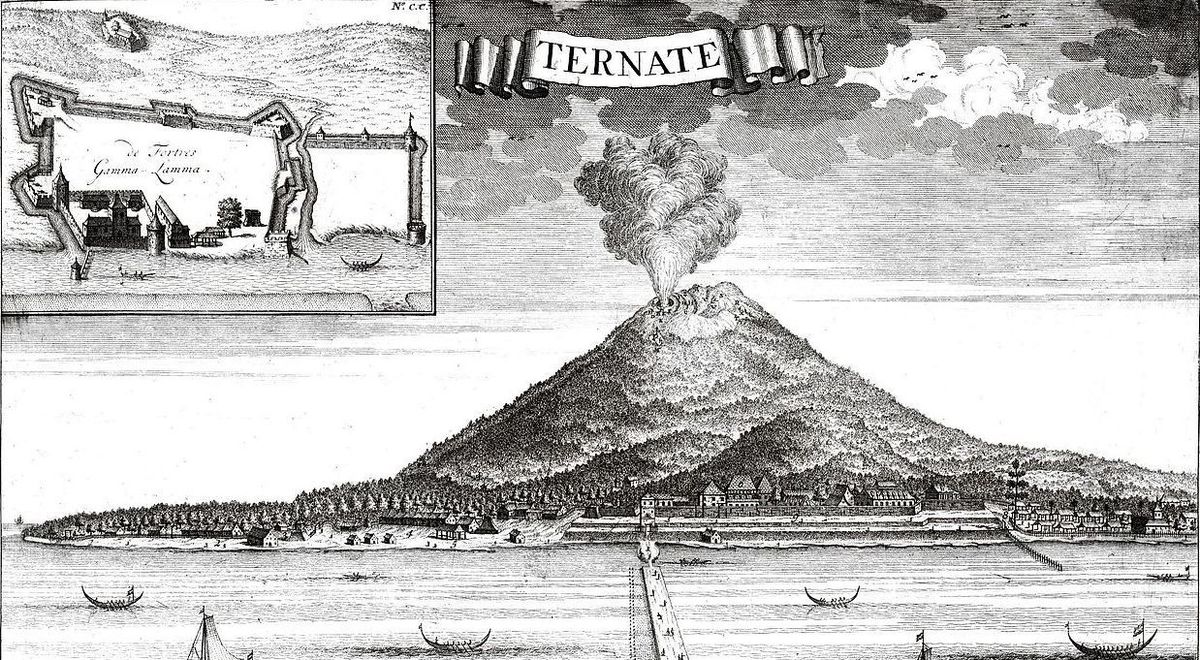
As part of the 2011 BBC documentary The Spice Trail, the presenter Kate Humble visited the clove-producing island of Ternate, which forms part of the Malukan archipelago in eastern Indonesia. Known in Shakespeare’s day as the ‘Moluccas’, early modern Europeans competed furiously for access to the cloves that were produced in these Southeast Asian islands.
The documentary shows an elaborate procession accompanying Humble’s entry to the Ternatean palace, where she is received by the Sultan and made an honorary citizen of Ternate, complete with an ornate sash referring to her as a ‘Princess’. In her subsequent conversation with the Sultan, Humble said she understood that becoming a ‘princess’ of Ternate meant that she was to be an ambassador for the island.
Intriguingly, in some ways, the Sultan’s decision to use a ‘princess’ of Maluku to help raise awareness of his spice-producing island home resonates with the approach taken within an English play, nearly 400 years before Spice Trail first aired. Back in 1621, King James and his court watched a performance of The Island Princess, a tragicomedy written by John Fletcher, one of Shakespeare’s collaborators, who later succeeded him as playwright for the King’s Men. [1]
The Island Princess is currently the only extant English commercial play known to have been set in Southeast Asia before the 1642 closure of British theatres. Correspondingly, it has been receiving an increasing amount of scholarly interest for its fascinatingly complex portrayal of early modern encounters between Europeans and Muslim-led Maluku.
Fletcher’s tragicomedy is set in the same spice-producing region of Maluku that Humble visited and features both Ternate and the neighbouring island of Tidore. Within the play, a starry-eyed European arrival, Armusia, wonderingly–if naively–describes the archipelago as ‘the blessed islands / Where every wind that rises blows perfumes/ And every breath of air is like an incense’, presumably thanks to ‘the spices’ that the land produces. [2]
Like Spice Trail, Fletcher’s play features a ‘princess’ of Maluku. Unlike Spice Trail, though, the ‘princess’ who stars within Fletcher’s play is indigenous rather than British, as the tragicomedy traces the exploits of Quisara, sister to the king of Tidore.
Over the course of the seventeenth and early eighteenth centuries, Quisara’s adventures would repeatedly entertain British theatre audiences. The play was adapted thrice in the Restoration: first anonymously (around 1668-9), then by Nahum Tate (in 1687), and finally by Peter Motteux (in 1699), with Jeremiah Clark, Daniel Purcell, and Richard Leveridge contributing the music to this last offering. Motteux’s semi-operatic adaptation was especially successful and was performed until the 1730s. [3]
After this point, The Island Princess appears to have slipped out of theatrical favour. However, a trumpet march composed by Jeremiah Clarke for Motteux’s adaptation remains much-loved, and is described by the play’s 2013 editor, Clare McManus, as having ‘become the default accompaniment for British church weddings in the late twentieth and early twenty-first centuries’, with the play itself being revived in 2002 by the Royal Shakespeare Company. [4]
Across these varied productions, the figure of Quisara continued to enable theatrical audiences to better envision the distant, clove-producing islands of Maluku, thus forging and sustaining an imaginative connection between Britain and Southeast Asia.
Whether knowingly or otherwise, therefore, when the Sultan of Ternate bestowed the honorary title of ‘princess’ on Kate Humble in Spice Trail, he was in some ways enabling her to continue the legacy of Fletcher’s ‘Island Princess’, as she, like Quisara before her, took on the role of connecting Maluku with viewers in London and beyond.
Emily Soon
[1] The contextual information regarding The Island Princess in this blog post is taken primarily from Clare McManus’s Introduction to her edition of The Island Princess (Arden Shakespeare, 2013).
[2] Fletcher, The Island Princess, Act 1 Scene 3, lines 16-18, 21.
[3] McManus, ‘Introduction’, 73-76.
[4] See McManus, ‘Introduction’, 68, 2.
Title image accessed via Wikimedia Commons here.
