

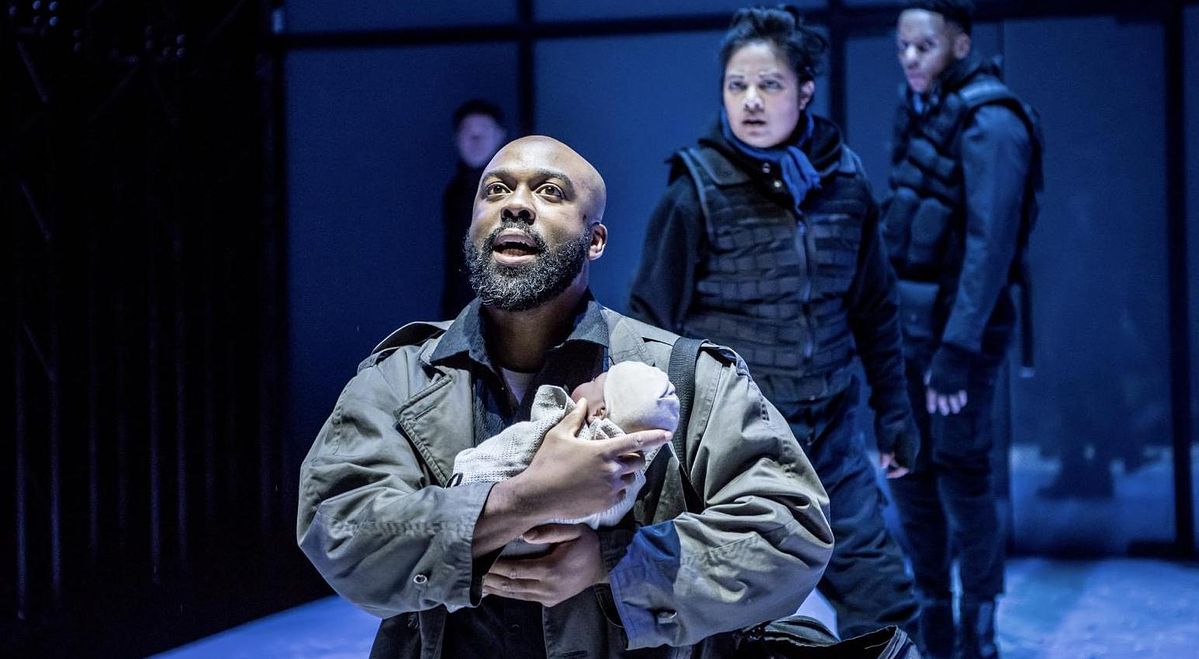
Gaza to Titus Andronicus: Children on the Frontline of Genocide
Palestinian Children as “Deliberate” Targets
On 18 June 2026 the UN Human Rights Council released a landmark report that established Israeli authorities and security forces ‘deliberately targeted Palestinian children resulting in genocide’ through ‘widespread and systematic killing and harming of children in Gaza’ from October 7 2023 onwards such that 30% of killings during the genocide were of children.[1] Violations included extermination and wilful killing, torture, sexual and gender based violence, and reproductive violence.[2] Commission chair, Srinivasan Muralidhar, observed that ‘by targeting children, Israel is attacking the very capacity of the Palestinian people to exist and to determine their future’ adding ‘Israel targets children to weaken demographic vitality’.[3] Violations extend to widespread targeting of healthcare facilities, including the systematic destruction of foetal, neonatal and maternal health infrastructure. The UN report notes, ‘Israeli authorities have destroyed in part the reproductive capacity of Palestinians in Gaza through the systematic destruction of sexual and reproductive healthcare.’[4]
The targeting of children and reproduction of a community is one of the most explicit and brutal tools of genocide wherever it is committed given its capacity to inhibit both survival and futurity. By the same token, children and reproduction have also formed a centrepiece of resistance to genocidal assault. Political resistance is not always through violent means. In genocidal circumstances, life, survival and continuity are themselves acts of resistance. This is true in Gaza, where large families are common- nearly half of the population are children aged under 18 and the birth rate is 3.3 births per woman compared to Britain’s 1.6 births per woman.[5] Furthermore, Palestinians have for years smuggled sperm from Palestinian inmates and hostages in Israeli prisons to birth families despite the apartheid carceral system that inhibits this.[6] An example is Karim al-Rimawi, who spent 25 years in prison and met his teenage son for the first time upon release in 2026.[7] His son was born in 2013 after al-Rimawi’s sperm was smuggled out of prison to his wife. Both the son, and an older daughter who was aged one at the time of al-Rimawi’s arrest, were raised in community by his wife and family in the Palestinian West Bank.
Community Resistance from Gaza to Shakespeare
Just as bearing and raising children in community despite genocidal circumstances are deployed as Palestinian acts of resilience and resistance, the same is illustrated in Titus Andronicus. We see all three aspects – birth, upbringing and community - in the case of Aaron the Moor and his mixed-race Black child in the face of the racialised genocidal intent of the play’s White imperial actors, both Roman and Goth. The infant is born of Aaron’s relationship with Goth Empress Tamora, but presents as Black like his father rather than taking his mother’s complexion. The scale of White genocidal impulse is made clear in the threat the Moor newborn faces and Aaron’s sole resistance to it. In Act IV Scene ii Aaron alone stands against a collective Goth desire to murder the infant, and in Act V Scene i he once again stands in individual resistance against collective Roman and Goth bloodlust towards his infant.
Aaron’s son first appears in Act IV Scene ii with the arrival of the nurse bearing the newly born child from Tamora. In this scene Gothic genocidal impulse towards Moorish progeny and futurity is shown in the desire of not only the baby’s Goth half-brothers Chiron and Demetrius to murder their new sibling, but in the instruction of Tamora to murder her own half-Moor child. This is illustrated perhaps most starkly in Demetrius’s desire to ‘broach the tadpole on my rapier’s point’ to which Aaron responds ‘He dies upon my scimitar’s sharp point / That touches this my firstborn son and heir’.[8] Demetrius invokes the White-coded Western European Renaissance weapon, ‘rapier’ in his bid to murder a Moor infant he grossly dehumanises as ‘tadpole’. Aaron’s rejoinder addresses this racialised and genocidal assault attentively, challenging not only with his Muslim-coded Moorish weapon, a curved ‘scimitar’, but raising the significance of his child to Moorish futurity as his own ‘firstborn son and heir’.
For Aaron, his child as ‘The vigour and picture of my youth’ and ‘heir’ denotes his Moorish future in Rome.[9] He does not only seek to protect his child in the present, but plans the infant’s upbringing and future, turning first to community to secure that. He invokes another Moor in Rome, Muly, who is described to have his own child who is White passing. Aaron’s plan is to switch the infants, and he is confident that ‘Muly my countryman’ will reciprocate the plan in a collective community effort towards survival and resistance. The Black child will thus be raised by Muly and his wife as their own while their White passing child will be raised as Tamora and Saturninus’s heir. By this both Moor children and families are preserved for futurity through a collaborative act of community. Aaron avoids Gothic ties of kinship and access to Roman halls of power via Tamora, preferring the bond of Moorish racial community for survival. Much like the Palestinian pursuit of self-determination and statehood over occupation and conditional incorporation into Israel, Aaron seeks Moorish community independence and security over volatile and conditional incorporation in imperial and genocidal White Goth and Roman spaces.
The Power of Children
Ultimately, however, Aaron does not succeed in protecting his child through community. Circumstances swiftly change in the play and in Act V, Scene i he is met with Roman murderous violence towards both him and his child. Here too, the Moor prioritises his child’s survival and futurity against an assault of White bloodlust that he resists alone. Lucius, in the presence of the Roman and Goth forces he commands, seeks to hang not only Aaron but ‘First hang the child, that he may see it sprawl’.[10] This depraved Roman command against a newborn infant faces no disquiet among the Romans and Goths present. Rather the Goths immediately respond and reciprocate by bringing a ladder and taking the infant from Aaron in preparation. Aaron alone seeks to ‘save my boy, to nurse and bring him up’, entering into negotiations that eventually secure the child’s future in exchange for information and Aaron’s own life.[11] Knowing how ‘T’will vex thy soul to hear what I shall speak’, he nonetheless delivers self-incriminating information sacrificing himself to save his son.[12] He further ensures the security of the agreement by forcing Lucius to swear on the Roman God to protect and raise the child.[13] Against his own life and beliefs Aaron secures the future of his Moorish progeny.
In genocidal circumstances, children are not just among the most vulnerable to endure assault. They are some of the most powerful figures and symbols of resistance, survival and continuity. Their presence holds a potency unmatched by any adult. For this they are targeted by genocidal actors who would see a community decimated in the present and future, from Gaza to Shakespeare’s Rome. Aaron understands this reality deeply, seeing in his son a potency and futurity that is far greater than himself. And so, he sacrifices himself to save his Black son who will continue the Moor legacy and line.
Title Image: Ken Nwosu as Aaron, Hampstead Theatre, September 2025. Photo by Genevieve Girling. https://www.theplaypodcast.com/titus-andronicus-footnotes/
[1] https://www.youtube.com/watch?v=pdj_Dci3JZ4; https://www.ohchr.org/en/hr-bodies/hrc/co-israel/index; https://www.ohchr.org/sites/default/files/documents/hrbodies/hrcouncil/sessions-regular/session62/a-hrc-62-crp-2.pdf; https://www.ohchr.org/sites/default/files/documents/hrbodies/hrcouncil/coiopt/coiopteji-crp-hrc62-infographic-1.pdf
[2] https://www.ohchr.org/sites/default/files/documents/hrbodies/hrcouncil/coiopt/coiopteji-crp-hrc62-infographic-2.pdf
[3] https://www.aljazeera.com/news/2026/6/23/israels-deliberate-targeting-of-gaza-children-part-of-genocide-un-inquiry; https://www.youtube.com/watch?v=pdj_Dci3JZ4
[4] https://www.ohchr.org/sites/default/files/documents/hrbodies/hrcouncil/sessions-regular/session62/a-hrc-62-crp-2.pdf
[5]https://data.worldbank.org/indicator/SP.DYN.TFRT.IN?end=2024&locations=PS&start=1990&view=chart; https://www.reuters.com/world/middle-east/5000-lives-one-shell-gazas-ivf-embryos-destroyed-by-israeli-strike-2024-04-17/
[6] https://www.amnesty.org/en/latest/campaigns/2022/02/israels-system-of-apartheid/
[7] https://www.reutersconnect.com/item/palestinian-prisoner-abdulkarim-rimawi-reunites-with-family-after-25-years-in-israeli-prison/
[8] Titus Andronicus, IV.ii.89,95-96
[9] Titus Andronicus, IV.ii.112,96
[10] Titus Andronicus, V.i.51
[11] Titus Andronicus, V.i.84
[12] Titus Andronicus, V.i.62
[13] Titus Andronicus, V.i.84
