

Unruly Muslim Women and the Construction of European Masculinity in Philip Massinger’s The Renegado
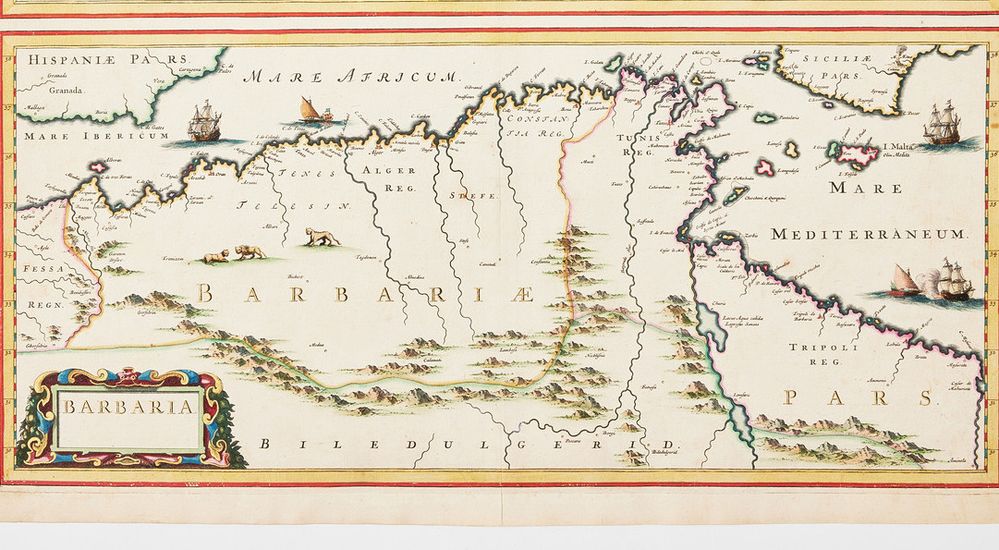
The Renegado (1624) is a play centrally concerned with Muslim-Christian encounter in North Africa, the region known in the period as the Barbary Coast. The plot is structured around the fears of captivity, conversion, and castration, often associated in the European Christian imagination with the Ottoman regencies of Tunis, Algiers, and Tripoli. It is also a narrative of wish fulfilment in which English audiences witness Christians not only escaping their captivity in Tunis and avoiding conversion to Islam, but also successfully gulling the ruler of Tunis, dey Asambeg, and escaping on one of his own galleys in the company of the Sultan’s own newly baptised niece, Donusa. No less importantly, as I show in this blog, the play participates in contemporary discourses constructing European masculinity in contrast to Muslim masculinity through its employment of the figure of an unruly Muslim woman.
Jonathan Burton has convincingly argued that, in dramatised Christian women’s ‘contrived encounters with Muslim men, they are provided with a site in which they may exercise their strength without posing a threat to Christian patriarchy.’ Such representations, he asserts, offer ‘English men […] a fantasy of unchallenged Christian manhood.’[1] I wish to complicate Burton’s argument by asking: What happens when the woman exercising agency over Muslim men is not a Christian, but rather a Muslim? Using The Renegado as a case study, I argue that this scenario performs a significant additional function: that of reinforcing notions of European male superiority demonstrated through patriarchal control of unruly women, a feat the fictionalised and feminised Muslim characters in the play fail to accomplish. In this way, control of intractable Muslim women becomes a site of race making, constructing European racial, religious, and masculine superiority in contrast to perceived Muslim inferiority.
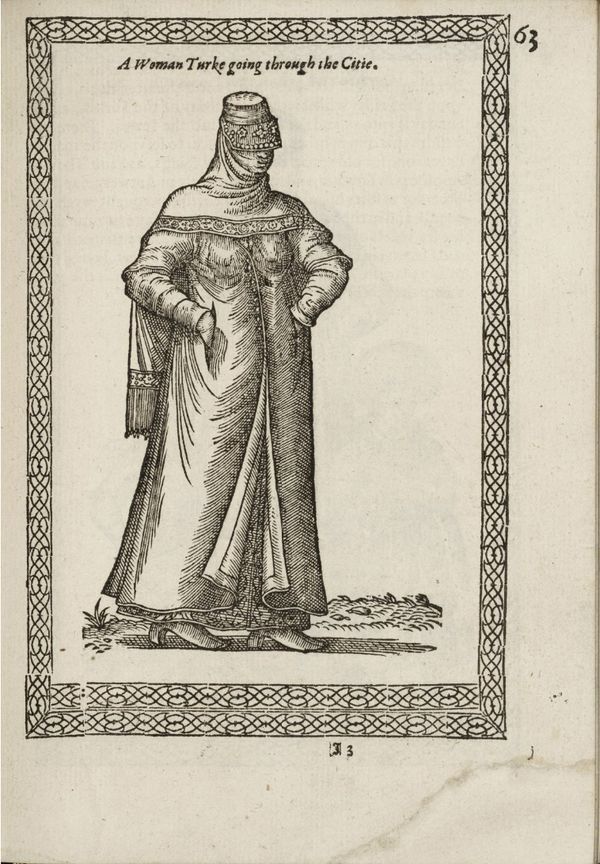
Fig. 1. ‘Woman Turke going through the Citie’ [[2]]
The play wastes no time in establishing the Muslim princess Donusa’s authority and power. The fictionalised Tunis is nominally under the governance of dey Asambeg, who rules in the name of the Ottoman Sultan (‘in me’, he bombastically informs the recalcitrant pirates, ‘great Amurath spoke’).[3] However, we quickly learn that his rule is undermined by the fact that Donusa, the Ottoman princess and the Sultan’s niece, holds a rival court in the land. In fact, when Donusa first receives her lover, the Christian Vitelli, in her chambers, the guards, puzzled by the identity of this stranger, decide that he must be ‘some disguised minion of the court, / Sent from great Amurath to learn from her / The Viceroy’s actions’ (2.2.3-6). For the guards, Donusa is aligned with the Sultan, while Asambeg is no more than an employee who, not trusted to govern effectively, needs a watchful eye on his actions. Nor is this a passing comment. Donusa herself will describe her power and access to material and symbolic resources in Tunis as equal to the Sultan himself. ‘But fancy’, she promises Vitelli in the process of seducing him, ‘any honour in my gift – / Which is unbounded as the Sultan’s power – / And be possessed of ’t’ (2.4.88-9).
The Muslim ruler, Asambeg, by contrast, is associated with the world of women, domesticity, and unproductivity, traits that seem to go hand in hand in the misogynistic logic of the play. The pirate Grimaldi, bitter at Asambeg’s apparently insatiable desire for plunder, mocks his ‘unmanly […] sit[ting] at home / And rail[ing] at us that run abroad all hazards, / If every week we bring not home new pillage / For the fatting his seraglio’ (2.5.13-6). This gendering of the roles of husband and wife and his casting of Asambeg in the role of the latter comes straight out of early modern conduct literature.[4] Tellingly, Asambeg himself, courting the captive Paulina, self-consciously adopts a feminine role. ‘[T]here is something in you’, he informs her, ‘That can work Miracles […] / Dispose and alter sexes’, offering willingly, ‘I will be your nurse, / Your woman, your physician and your fool’, subject positions which not only strip away his manliness (‘nurse’, ‘[waiting-]woman’), but also subvert the social hierarchy and places him outside the boundaries of rational masculinity (‘fool’) (2.5.149-53).
Similar to Asambeg, Mustapha, Donusa’s suitor and the ruler of Aleppo, is positioned as a feminine figure even as he performs the traditionally masculine-coded role of suitor. Entering the stage as a suitor to the Sultan’s niece, Mustapha is immediately placed as supplicant for her favour and as inferior to her. Donusa is insistently associated with power and influence in these early scenes, and she ensures that the disparity between their social positions translates materially on the stage. Stage-managing the scene, she orders her attendants to ‘Reach a chair’, for, ‘We must / Receive him like ourself, and not depart with / One piece of ceremony, state and greatness / That may beget respect, and reverence / In one that’s born our vassal’ (1.2.54-8). When we first meet them together, Mustapha is shown performing rituals of reverence, blasphemously describing her chamber as ‘sacred’, a place where he ‘Enter[s] […] with such devotion / As Pilgrims pay at Mecca when they visit / The tomb of our great Prophet’ (1.2.59-62). Their next meeting follows her encounter with Vitelli in the marketplace and the immediate bestowal of her affections on him, a state of affairs which results in further humiliation for Mustapha, now seen as additionally inferior to his European rival. Stepping into the role of scornful mistress, Donusa mocks Mustapha’s puzzled silence, suggesting that he will be well suited to the position of mute and reminding him of her powerful familial connection: ‘If you have lost your tongue, and use of speech, / Resign your government. There’s a mute’s place void / In my uncle’s court, I hear’ (3.1.36-8). This suggestion inserts him rhetorically within a feminine position, as silence was one of the virtues often recommended for women in early modern conduct literature.[5]
In contrast to the feminised and inefficient Muslim men, Vitelli, though he at first falls for Donusa’s charms, proves sufficiently in control not only to resist her attempts to convert him to Islam but, more strikingly, to convert her instead to Christianity, transforming this formerly unruly and emasculating woman into an embodiment of docile femininity. The ending portrays the Christians’ triumph over the Muslims’ attempts at conversion as intertwined with the European male character’s reassertion of normative gender roles. Notably, Donusa’s conversion turns her, in her own words, into ‘another woman’, one who embraces the obedience and submission early modern preachers prescribed as ideal attributes of femininity (5.3.121). The previously rebellious and sexually assertive Donusa addresses Vitelli as he prepares to baptise her: ‘As your humble shadow, / Lead where you please, I follow’ (5.3.85-6).
The deployment of perceived difference between European and Muslim patriarchy in processes of race making is not unique to this play. Early modern Europe, as Kim F. Hall has demonstrated, was ‘obsess[ed] with African difference and sexuality’, negatively judging both against European norms and practices. This is nowhere more evident than in the influential work of scholar and traveller A1 Hassan Ibn Mohammed Al Wezaz, Al Fasi, a converted Moor, better known as Johannes Leo Africanus. Leo Africanus’s A Geographical Historie of Africa (translated into English by John Pory in 1600) became ‘the single most authoritative travel guide on Africa for the next three centuries’.[6] In this work, North African sexuality appears as unruly, uncontrollable, and deviant. The ‘principal and notorious vices’ of Africa, Leo Africanus asserted, related to the licentiousness and promiscuity of women who, he stressed, led lives free from patriarchal supervision. Specifically referring to the people of ‘Barbarie’, that is, Donusa’s people in The Renegado, among others, Leo Africanus condemns African fathers as ineffective patriarchal figures whose failure to police their daughters’ sexuality not only disrupts the patriarchal system but also, as Hall notes in her comment on this passage, ‘causes troubles in the state as well: no “nobles or gentlemen” can find virgins to wed and thereby guarantee themselves the continuation of an untainted aristocratic bloodline’. According to Leo Africanus, African
yoong men may goe a wooing to divers maides, till such time as they have sped of a wife. Yea, the father of the maide most friendly welcommeth her suiter: so that I thinke scarce any noble or gentleman among them can chuse a virgine for his spouse: albeit, so soone as any woman is married, she is quite forsaken of all her suiters; who then seeke out other new paramours for their liking. [7]
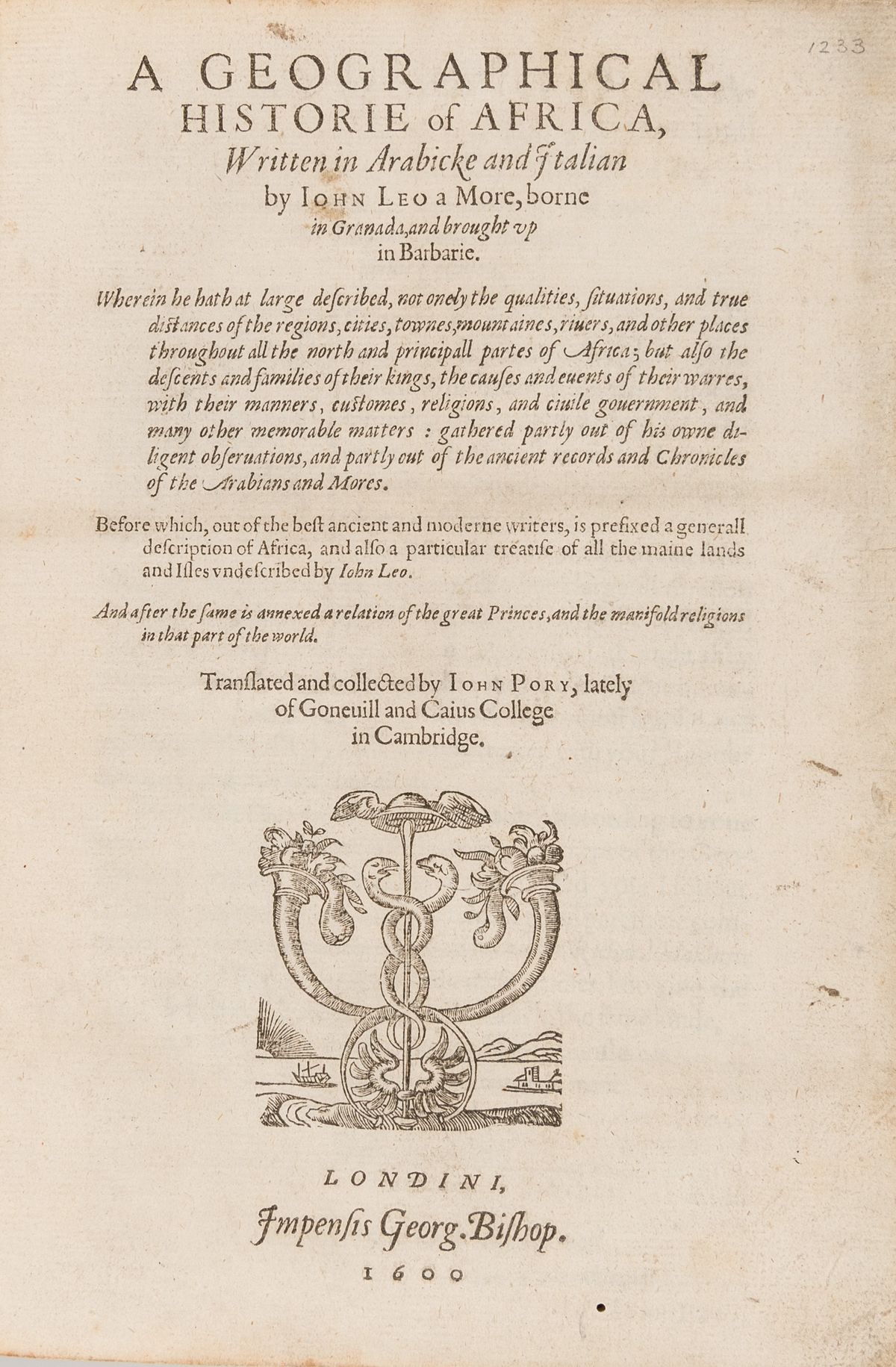
Fig. 2. The title page of the 1600 English edition of Leo Africanus’s Geographical Historie [[8]]. Accessed here.
Representations of Muslim women in early modern drama, as much as discourses surrounding Muslim women produced and circulated in the Western world today, were never free from processes of race making. Patriarchal control of unruly femininity establishes a European and Christian masculinity allegedly superior to Muslim masculinity. In our present day, the tide has turned: European masculinity today is imagined in racist circles as the exact opposite of Muslim masculinity. Where the latter is framed as controlling and violent, the former presents itself as progressive and embracing of gender equality.[9] Tellingly, then as now, this battle is often fought over women’s bodies.
Iman Sheeha
Notes
[1] Jonathan Burton, Traffic and Turning: Islam and English Drama, 1579–1624 (Newark: University of Delaware Press, 2005), 109.
[2] From Nicholas Nicholay, The Navigations, Pereginations and Voyages made into Turkey (London: 1585), sig. I3r. [Image Source: Folger Library].
[3] Philip Massinger, The Renegado, ed. by Michael Neill (London: Arden Shakespeare, 2010), 2.5.33. All quotations are taken from this edition and will be cited parenthetically in the text.
[4] See, for example, Edmund Tilney, The Flower of Friendship: A Renaissance Dialogue Contesting Marriage. 1568, ed. by Valerie Wayne (Ithaca NY: Cornell University Press, 1992), 120-21.
[5] See Suzanne Hull, Chaste, Silent, and Obedient: English Books for Women, 1475-1640 (San Marino: Huntington Library, 1982).
[6] Kim F. Hall, Things of Darkness: Economies of Race and Gender in Early Modern England (Ithaca: Cornell University Press, 1995), 29.
[7] Ibid., 33-4.
[8] The title page of the 1600 English edition of Leo Africanus’s Geographical Historie, accessed here.
[9] See Lila Abu-Lughod, ‘Do Muslim Women Really Need Saving? Anthropological Reflections on Cultural Relativism and its Others’, American Anthropologist 41:3 (2002): 783-790.
Title Image: Map of the Barbary Countries, circa 1690, accessed here.

