

When No Single Power Held Hegemony: Thomas Bowrey’s Account of Bay of Bengal (1669-1679)
In the bustling maritime world of the seventeenth century Bay of Bengal, commerce thrived as a form of economic cosmopolitanism, a phenomenon where the boundaries of race and religion seemed to dissolve, where Hindu ‘gentiles’, ‘Muslim ‘moors’, Coromandel’s Chuleas (Chuliah), Hadhrami Arabs from Southern Arabia, Bugis from Sulawesi, Buddhist Siamers and diverse Europeans collaborated and competed with a fluidity that transcended sectarian loyalty. These were the unique economic, social and political interactions, decentralised, yet multipolar, that Thomas Bowrey meticulously documented during his nineteen years in the East. His account reveals a world where no single power held hegemony, and where merchant networks functioned as autonomous poles of influence within a complex system of non-Western polities and burgeoning European interest.
To understand this Indian Ocean cosmopolitanism, one must view the region through the theoretical lens of modern scholars Nitin Agarwala, Rila Mukerjee, or Manjeet Pardesi, who frame the Bay of Bengal and Malacca not as peripheral spaces but as historically cohesive centres of maritime activity. Agarwala (2020) argues that the Bay of Bengal has functioned as a maritime thoroughfare since time immemorial, acting as a neighbourhood where both cultural and commercial circulations fostered a natural unity before the fracturing effect of colonialism of the Western European maritime nations. This framework posits that regional identity was built on cross-cultural networking and regional agency, where multiple littoral states, polities, and autonomous bodies participated in a seamless flow of goods and ideas. Mukerjee (2022) further refines this by highlighting an Asian maritime network centered on the Straits and open seas, creating a system in which local economies and hard-money networks facilitated what Manjeet Pardesi (2021) called a decentred hegemonic global order. This theoretical foundation suggests that the 17th century trade that Bowrey encountered was a continuation of an ancient, integrated prevailing maritime ecosystem, one characterised by economic and trade pillars that operated independently of Western hegemonic trade and economic structures. By viewing the Bay as a temporal and spatial site, we see that Bowrey’s observations were the documentation of a precolonial, global international system at its peak.
Thomas Bowrey’s primary contribution to the history of the Indian Ocean is his manuscript titled A Geographical Account of Countries around the Bay of Bengal, 1669 to 1679. This extensive work, published by Lt. Col. Sir Richard Carnac Temple for the Hakluyt Society, spans approximately 326 pages of detailed observations and is accompanied by numerous pen and ink drawings of native crafts and social customs. The Table of Contents reflects a wide geographical and thematic scope, including geographical sections such as Choromandel, Golcondah, the Coast of Gingalee, Orixa (Orisa), Bengala, Pattana, Janselone (Thailand), Queda and Achin.
The author, Thomas Bowrey, was born around 1650 into a family with deep naval roots, potentially related to Captain John Bowrey of the Royal Navy. Arriving in India in 1699, Bowrey spent nearly two decades as an independent trader and sailing master. Unlike the official servants of the English East India Company (EIC), Bowrey operated as a free merchant, commanding his own vessels in the country ship trade. This status allowed him to observe Anglo Asian seafarers’ lives and native society without the petty spitefulness often found in official company records, making him a unique chronicler of the decentralised power structures of the era.
The world system Bowrey encountered was defined by its multipolarity, where authority did not flow from a single centre like London or Delhi, but was distributed among various local and foreign entities. In this framework, the Bay of Bengal was not a region under European conquest or occupation, but a high-stakes marketplace where the English East India Company was merely one of the many poles of influence, and often a defensive one at that.
Bowrey’s account emphasizes that the seventeenth-century EIC’s authority was frequently subordinate to local rulers. For instance, while the EIC claimed its people were free merchants not governed by native laws, they were nevertheless compelled to pay customs and negotiate with local officials. The lack of hegemony created a universal commercial space where different groups- the Moors, the Malays, Chuleas, Chinese, Danes, and the Portuguese- all navigated the same complex jurisdiction. The power in this system was decentralised, often resting in the hands of regional officials such as the Avaldar (collector of revenue) or the subidar (governor). Bowrey himself experienced this decentralised power firsthand when he was imprisoned and placed in irons by the Avaldar at Portonovo over a trade dispute involving a local merchant, Amad Marcar.
The economic cosmopolitanism of the region was best exemplified by the port of Achin in Sumatra. Bowrey describes Achin as a city with ‘great Traffic and Commerce’ that was never without ships from various origins, regardless of the reason. Here, merchant networks formed the primary engine of global order. This network included Asian commercial poles where vessels from Surat, the Malabar Coast, Pegu, Siam, China, Great Java, and Borneo converged in Achin. There were also diverse participants in trade, driven by infinite numbers of prows from the Malay shore alongside the sophisticated operations of the Chuliah and Chinese merchants. Furthermore, independent Western merchants like Bowrey operated outside the monolithic structure of the EIC, integrating into local trade routes.
In this environment, differences of religion and race were secondary to commercial reliability. The networks were universal because they relied on shared maritime knowledge and commodities. Bowrey’s own expertise, such as his practical knowledge of the Hughli River’s configuration and his ability to manufacture pitch and tar using native dammar and oil, illustrates how technical and commercial skills served as a universal currency across cultural divides.
The economic system was underpinned by stability and the administrative frameworks of the Bay of Bengal’s Muslim sovereigns. The Sultanate of Achin, for example, had been governed by a system of queens and twelve lords (uleebalangs) for over half a century. This local political structure provided the necessary oversight for the bustling international marketplace.
Bowrey’s account provides precise definitions of native potentates, such as the rajah, indicating a deep respect for the established Mogul and regional ruling hierarchies. The trade in commodities like tin, abundant in Thailand, Perak and Kedah, and pepper was regulated by these local powers, who exercised decisive influence over customs and trade disputes. The dispute between Bowrey and Amad Maricar over 100 slaves and customs payments highlights how local merchants could leverage the power of the state (divan) to protect their interests against European interlopers.
Furthermore, these regional polities were active participants in the multipolar conflict. Bowrey’s fear of weathering in the Achin port because the “Siamers were now at wars with the English” demonstrates that polities adjacent to the Indian Ocean were significant military and diplomatic poles, capable of challenging European presence. The arrival of a French frigate carrying a Siamese ambassador further illustrates the complex, multi-layered alliances that characterised this era.
In conclusion, Thomas Bowrey’s Geographical Account serves as a vital record of a global order that was interconnected yet decentralised hegemonically. It captures a moment in history before the rigid hierarchies of colonialism stifled the economic cosmopolitanism of the Bay of Bengal. In Bowrey’s world, the free merchant was a bridge between diverse power poles, navigating a system where a Muslim merchant, a Dutch captain, and a Mogul Indian official were all essential cogs in a universal engine of commerce.
Ultimately, the Bay of Bengal during this period was a bustling, high-stakes international marketplace where no single power could yet assert total control. By documenting this multipolar reality, Bowrey ensured that his reputation would be tied not just to his own seafaring success, but to his role as a chronicler of a sophisticated, non-hegemonic global trade system that flourished long before the era of Western dominance.
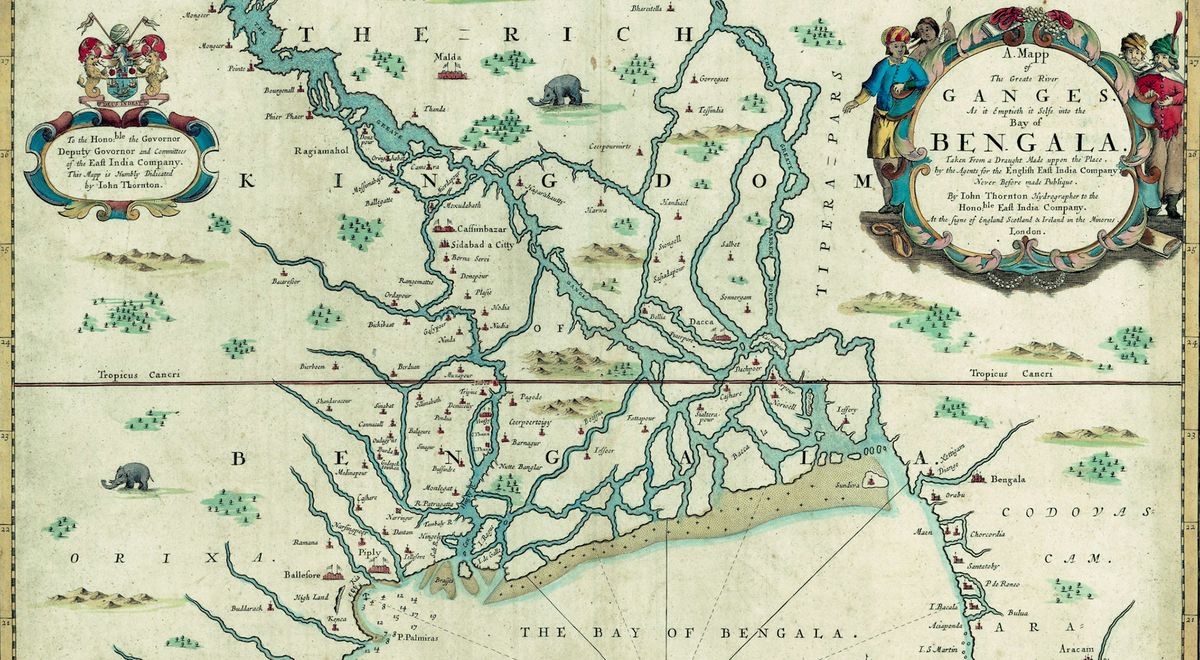
Title Image: Map of the river Ganges emptying itself into the Bay of Bengal, published by John Thornton, London, circa 1680, accessed here.
Further reading:
Agarwala, Nitin, ‘The Re-emergence of the Bay of Bengal’, Journal of Territorial and Maritime Studies, 2020, Vol. 7, No. 2., pp. 49-73.
Bowrey, Thomas, Geographical Accounts of Countries Around the Bay of Bengal 1669-1679, Cambridge: Hakluyt Society, 1905.
Mukerjee, Rila, ‘An Uncertain Fortune’, Journal of the Economic and Social History of the Orient, 2022, Vol. 65, No.3, Special Theme Issue, Asian Maritime Networking Centred in 15th Century Melaka, pp. 378-414.
Pardesi, Manjeet, ‘Decentering Hegemony and “Open” Orders: Fifteenth-Century Melaka in a World of Orders’, Global Studies Quarterly, Volume 2, Issue 4, October 2022, ksac072, https://doi.org/10.1093/isagsq/ksac072
Nia Deliana earned a Ph.D. from the Faculty of Human Sciences, International Islamic University of Malaysia (IIUM). Currently, She teaches politics and international relations in the Faculty of Social Sciences at Universitas Islam Internasional Indonesia located in Jawa, Indonesia. She is the author of The Ocean Remembers: Indians and the Tide of Empires, published by Malaysia's GerakBudaya in 2026.
Dr Mehmet Ozay is an Associate Professor at the International Institute of Islamic Thought and Civilization (ISTAC), International Islamic University Malaysia (IIUM). Mehmet Özay is currently a full-time lecturer and researcher in the International Institute of Advanced Islamic Thought and Civilization at the International Islamic University of Malaysia (ISTAC-IIUM). He can be reached at [email protected]; Orcid No: https://orcid.org/0000-0002-2719-1543 [orcid.org].
