

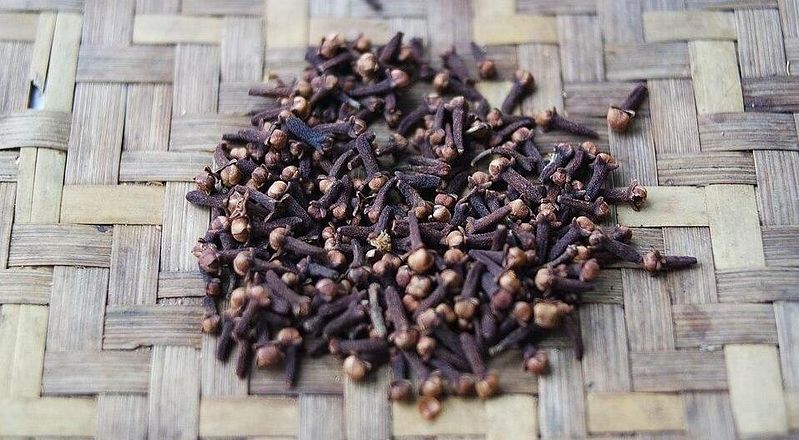
Tiny Treasures: Cloves in Early Modern English Literature
What do gingerbread cookies, mulled wine and garam masala all have in common? Well, they all feature cloves.[1]
Today, whole or ground cloves are used in a wide range of recipes, and are commonly found in kitchen cupboards, markets and shops. In the early modern period, however, this spice was relatively much more expensive, and for many Europeans, far harder to obtain, for these items were initially grown only in the so-called ‘Spice Islands’ of the ‘Moluccas’ (Maluku) in what is now eastern Indonesia.[2] Antonio Pigafetta, who travelled with Ferdinand Magellan on his 1519-1522 circumnavigation of the world, hence deemed the clove tree (and the islands where they grew) to be so important that he included an illustration of this tree and ‘the Five Islands Where Grow the Cloves’ in his account of this epic voyage.[3] Over time, Europeans competed fiercely to gain access to this and other precious spices (such as nutmeg, mace and pepper) grown in Southeast Asia. This quest for these items often turned violent, with Europeans clashing with both Asian communities and rival Western groups.
Apart from influencing the course of global economics and politics, the clove also found its way into English literature. Prior to the early modern period, cloves had already featured within medieval English writing: they are mentioned in the dream poem, Pearl, as well as in Geoffrey Chaucer’s Canterbury Tales, with its reference to ‘many a clowe-gylofre’ or clove within the Tale of Sir Thopas.[4]
As direct maritime trade between Europe and Southeast Asia increased during the Global Renaissance, cloves reappeared within English literary culture, with Jillian Azevedo noting that cloves appear in twenty-four English plays from the seventeenth century.[5] In the rest of this post, I introduce a few ways this spice featured in early modern literature.[6]
On occasion, actual cloves seem to have been used in performance. This appears to occur in The Triumphes of Re-United Britania (1605), a civic pageant written by Anthony Munday and performed in the streets of London. There, the Master (‘Maister’) of the pageant ship tells his crew to ‘[t]ake of our Pepper, of our Cloves and Mace, / and liberally bestow them round about’.[7] As Richad Dutton suggests, the performers may have thrown ‘small packages’ with these items from the pageant ship to the watching crowd.[8]
Within commercial plays, cloves could feature within the dialogue, or even as a character. For instance, Ben Jonson’s Cynthias Revels, or the Fountain of Selfe-Love features a description of a character who walks ‘with a Clove … in his mouth’, while his Every Man Out of His Humour contains a pair of characters called Clove and Orange.[9] Elsewhere, given the way cloves tended to be ‘“stuck” into other foods’, such as oranges and gammon, Azevedo notes that dramatists often played around with the idea of cloves being poked into things.[10] Jonson appears to allude to this in Every Man Out of His Humour, when he writes that one character, Clove, ‘serves to sticke [another character, Orange], with Commendations’. [11]
More obliquely, John Fletcher’s tragicomedy The Island Princess – the only extant commercial play set in Southeast Asia prior to the 1642 closure of the theatres – also has a character, Armusia, wax lyrical about the spices produced in Maluku. There, he speaks of how ‘[e]ach tree’ ‘bring[s] forth immortal fruit’, in the form of ‘spices’ that ‘fal[l] by time’.[12] While Armusia does not name these ‘spices’, given that the play was set in Tidore and Ternate, two clove-producing Malukan Sultanates, it is likely that this reference would have been to cloves. After all, this spice consists of the flower buds harvested from the clove tree that were then dried in the sun.
That said, not all literary references to cloves are celebratory, comical or otherwise lighthearted. European writers were also alert to the high human costs arising from the international competition over this spice. This can be seen from Sir Richard Fanshawe’s 1655 The Lusiad, which is his English translation of the Portuguese Luís Vaz de Camões’s epic poem, Os Lusíadas (first published in 1572). There, when giving a poetic survey of the ‘Orientall Seas’, the narrator points out the islands of Tidore and Ternate, with their ‘Trees of burning Cloves, that shall be sold / For LUSIANS blood, and water’d with the same’.[13] Here, the image of the ‘burning Cloves’ captures the vivid red colour of the ripening buds (and of any flowers left in full bloom on the trees), a shade that matches the crimson ‘blood’ of the Portuguese (or ‘LUSIANS’) that was spilled in the process of seeking access to this spice. While the narrator here singles out the pain of the Iberians, those familiar with developments in Southeast Asia would have known that local communities (and other Europeans) also suffered significantly as a result of the conflicts stemming from the spice quest.
Overall, then, for better or for worse, the clove not only contributed to shaping the diets and lives of individuals across Europe and Asia, but also played a part within the literary culture of the Global Renaissance, with the poetry and performances of this era variously celebrating, critiquing and lamenting the international fascination with these tiny treasures.
Title Image: ‘Cengkeh Indonesia’. Photo by Hersy Ardianty A, Wikimedia Commons, 6 January 2014, https://commons.wikimedia.org/wiki/File:Cengkeh_rempah.jpg.
[1] See ‘The Aromatic Legacy: Uncovering the Bold History of Ground Cloves’, Premium Spices, August 1 2025, https://www.premiumspices.co.nz/blogs/news/history-of-ground-cloves.
[2] See M. N. Pearson, Spices in the Indian Ocean World (Routledge, 1996), xxi. Also see Genie Yoo, ‘Cloves: The Spice that Enriched Empires’, JSTOR Daily, September 20, 2024, https://daily.jstor.org/cloves-the-spice-that-enriched-empires/.
[3] Image reproduced in ‘Spice Islands (Moluccas): 250 Years of Maps (1521-1760)’, Princeton University Library, 2010, https://static-prod.lib.princeton.edu/visual_materials/maps/websites/pacific/spice-islands/spice-islands-maps.html.
[4] On Pearl, see Barbara Janina Kowalik, ‘Oriental Spice-Plants in an English Garden: Explaining a Natural Impossibility in Pearl’, The Explicator 83, no. 4 (2025). On Chaucer, see Stephen Gordon, ‘Sensory Satires and the Virtues of Herbs in Sir Thopas’s Fair Forest’, Studies in Philology 119, no. 2 (2022): 193; and Alex J. West, ‘Cloves and Carnations’, May 25 2020, Medieval Indonesia, https://indomedieval.medium.com/when-is-a-clove-a-clove-peppercorn-rents-38916ef8aa11.
[5] Jillian Azevedo, Tastes of the Empire: Foreign Foods in Seventeenth Century England (McFarland & Company, 2017), 59.
[6] For more on spices in early modern discourse (including in Shakespeare), see Gitanjali Shahani, ‘The Spicèd Indian Air in Early Modern England’, Shakespeare Studies 42 (2014): 122–37.
[7] Anthony Munday, The Triumphes of Re-United Britania (London, 1605), A4v.
[8] Richard Dutton’s editorial note to The Triumphs of Re-United Britannia, in Jacobean Civic Pageants, ed. Richard Dutton (Keele University Press, 1995), 124.
[9] Ben Jonson, ‘Cynthias Revels, or the Fountain of Selfe-Love’ and ‘Every Man Out of His Humour’, in Ben Jonson, The Workes of Benjamin Jonson (London, 1616), R5v and G4v.
[10] Azevedo, Tastes of the Empire, 58-9.
[11] Jonson, ‘Every Man Out of His Humour’, G4v.
[12] John Fletcher, The Island Princess, ed. Clare McManus (Bloomsbury, 2012), Act 1 Scene 3 lines 19-23.
[13] Luís Vaz de Camões, The Lusiad, trans. Richard Fanshawe (London, 1655), Ff2r.

